
Chapter 15: Vertical and Horizontal Threads
(Vertical Threads connecting various cultures and peoples around the globe and Horizontal threads from the ancient to modern/ the classical to contemporary 縦横の糸:横は世界を巡り、縦は古典から現代)
Held three times a year, the Salon Series was a series of grassroots programs presented in various formats and on various subjects, informing and investigating aspects of Japanese cultural and artistic heritage. The dialogues between the world class guest artists and the audience often led to new insights and deeper understanding, not only of Japanese culture and art, particularly dance, but also human nature.
By the time of its conclusion in 2023, the Salon Series had presented 74 programs to the public, and three additional special anniversary concerts. The series lasted for 25 years, far longer than I had expected at the onset. This continuation was made possible not only by my passion to introduce Japanese art and culture to the world outside of Japan, but also by the support of the audiences and guest artists.
There have been many wonderful collaborators of such incredible artistry and kindness who have joined me at Salon Series. I have no words other than those of deep gratitude for their willingness to collaborate with me, the minor artist.
One of the aims of the Salon Series was to introduce Japanese art and dance forms in depth. In addition to dance and music performances, the demonstrations, lectures, audience participation, and Q&A sessions with the guest artists were important components of the programming. Audience members both familiar and unfamiliar with Japanese arts and culture had many questions. However, those who were familiar with the topics would ask questions that led to lively discussions, insightful perspectives, and new discoveries.
The Story behind the Salon Series: When Life Gives You Lemons, Make Lemonade
The inspiration of the Salon Series was not my lifelong mission to introduce Japanese arts to the wider world, but rather an unexpected criticism. After a concert I had given, a Japanese critic published a review that struck me—not for its harshness, but for its lack of understanding. What troubled me most was the critic’s unfamiliarity with traditional Japanese theater conventions: for example the visible presence of the Kurogo (Stage ssistant) who handle props in full view, and the absence of curtains to mark scene changes, unlike in Western productions. These practices are integral to the centuries-old Kabuki dances I present, and I realized then how vital it was to create a space where such traditions could be properly appreciated.
As I began performing outside Japan, my audiences were primarily non-Japanese. To bridge the cultural gap, I created a format of demonstrations and lectures tailored for American schools, libraries, and museums—spaces where knowledge of traditional Japanese theater was often limited. My goal was to convey how these original productions were meant to be experienced, honoring their conventions and heritage. So when a Japanese critic—someone deeply embedded in dance and theater—misunderstood these very traditions, I was taken aback. It made me realize that perhaps the need for cultural education was not limited to foreign audiences. Why not create a program that speaks to both Japanese and non-Japanese alike? It could be a presentation about our arts that goes beyond superficial information and explores Japanese arts in greater depth. Furthermore, discussions with featured artists would provide a valuable forum for the exchange of ideas. I hoped that this might serve both as enlightenment and entertainment. Little did I know that this tiny seed of an idea would grow to have a huge impact on my life, leading me to collaborate with great artists, scholars, and experts from all over the world—an incredible and fortunate privilege.
How It Began: A Gallery in SoHo
Having an idea does not bring a project to fruition. I went around to several cultural institutions with my proposal but was greeted only with rejection. Only one place, a small gallery in SoHo, showed any interest in the venture. One day I found myself on the street outside of Tenri Cultural Institute, uncertain if I was in the right place or not. “Plucking up my courage,” to use the English idiom, I knocked on the door and was graciously welcomed inside by Reverend . Toshihiko Okui, the institute’s director. I presented my plans and waited while he considered them.
Finally, he said, “Well then, let’s begin and see.” Thus, my proposal was accepted. No words can express how grateful I am to Reverend. Okui, for at the time, I was nothing but an unknown dancer and a stranger to him. He would later connect me to the Tenri Gagaku Society of New York, which became one of the few guest artist groups I would invite to the program repeatedly, another thing for which I owe the reverend a debt of gratitude. Not long after our initial meeting, Tenri moved to its current location on 13th Street, and I presented the Salon Series there for more than twenty years.
Salon Series No. 34 featured the second collaboration with the Tenri Gagaku Society of New York. I wanted to introduce the ancient Japanese songs, a part of the Gagaku repertory, since we had introduced the repertory imported from other parts of Asia to Japan in the earlier Salon program. For this occasion, I created a trio dance called Kashin. I chose the song Kashin for this new work because I was very intrigued by how it resonated with a song from Sui Dynasty in the 7th century China. The song says, “Let’s celebrate this happy occasion! May this joy be limitless, last ten thousand years, and grow forever!”
The fact of the matter is that it was not easy to follow the words of the song. My dancers, and even I, from time to time, got lost as to where we were in the music while rehearsing. This was because the prolonged vowel sounds lasted several minutes. During the program, I showed the Kanji characters to the audience on a large piece of paper, while I had one of the singers pronounce each word.
In contrast to the slower rhythms of the past, the modern world is acutely aware of time, measuring not just hours but minutes and seconds. Japan, in particular, has become synonymous with punctuality. This brings to mind a memory from my high school days. I had a date with a friend and we were to meet at Shibuya Station, the closest station to my school. He was late. As I waited, my anxiety grew—I worried about his safety, wondering if an accident had caused the delay. An hour later, he finally arrived and confessed that he had wanted to test whether I would wait for him. Looking back, I doubt many people today would wait more than thirty minutes for someone.

Salon Series #34: Gagaku and Ancient Song of Japan
Comparison with Various Dance Cultures
From the very inception of the Salon Series, I have been eager to present comparative studies of dances in Asia. The countries I included in the Salon Series were Okinawa, China, India, Korea, Tibet, and Indonesia. We held programs featuring Indonesian and Okinawan dance on more than one occasion.
Okinawa is the southernmost tip of Japan, and due to its geographical location, unique history, and the diversity in its arts, it is one of the most interesting regions to explore among southeast Asian countries.

My fascination with Okinawa began when I first visited the islands in 1976. In the 1970s, I began researching the roots of Japanese dance, and in Okinawa I discovered beauty and traditions that the mainland may have lost over time. Eventually, my interest led to my doctoral dissertation, The Origins of Okinawan Dance, which I discussed in Chapter 8.
Because of interest shown by artists and audiences in the similarities and differences between Japanese mainland and Okinawan culture, I presented many programs with Okinawan themes, often comparing music and dance. One of the themes of these programs was Karate and Okinawan dance. I was pleasantly surprised and happy when the first Karate program attracted a large audience, more than a full house, so I added two more Karate and Okinawan dance programs with different focuses and different Karate masters. And yet, Okinawan Court Opera: National Identity of Okinawa, a program about Tamagusuku Chokun, the 18th century dance master and creator of Kumi Odori (Okinawan Court Opera) did not attract a crowd. Perhaps I was the one who enjoyed it more than the audience, because I was passionate about voicing how important the arts are to cultural identity, not only for Okinawa, but for every country.
In addition to traditional Okinawan dances, I was also keen to introduce contemporary Okinawan dances in the Salon Series and in my company’s home season concerts. The dance that stood out for me was Nanyo Hamachidori (Plovers in the Southern Pacific). Fortunately, I was given permission to perform this dance by my teacher Takako Sato a decade before the start of the Salon Series. She had restaged the dance as a solo piece for her group’s concert at Asia Society in 1986.
Hamachidori (Plovers on the Beach) was choreographed by Tamagusuku Seiju in the late 19th century. It features a distinctive hand gesture derived from the court dance technique: a soft, undulation of hand known as Koneri-te (Kneading hand). Around 1930, Iraha Inkichi adapted this piece into Nanyo Hamachidori, incorporating Koneri-te along with elements of ballet following his tour in Hawaii. These gestures and innovative movements continue to captivate anyone who experiences Okinawan dance.
Securing sponsorship from the Asia Society and the Okinawa American Association of NY for this performance was no easy task, but I was deeply grateful for their support. I believed that New York audiences deserved the opportunity to discover the beauty and artistry of Okinawan dance.
*Ms. Sato’s performance marked the second visit by an Okinawan dance troupe to New York City, while the first being Miyagi Minoru’s troupe in 1981.
As part of my ongoing exploration of hand gestures, I invited guest artists from Indonesia to participate in two separate programs.
In one of the Indonesian collaborations, Salon Series No. 10 with Dr. Deena Burton, we explored the theme of female power in the performing arts in each culture. During a time when dominance by men was the norm in all parts of society, there was yet a strong feminist voice in the performing arts. While the idea of women's empowerment and equality became more mainstream in the new millennium, our conversations in the early 1990s about female strength in each other's traditional dance forms were strikingly unique and ahead of their time.
Influence and Comparison of Japanese Classical Theater Forms with Contemporary Theatre and Dance Forms
The historical progression and evolution of art forms have always been of great interest to me, and I wanted to compare the traditions I was familiar with to contemporary dance, such as Butoh and ballet, and contemporary theater.
In Salon Series No. 62: Traditional Japanese Dance and Theater in Contemporary Performing Arts, my guest speaker and artist were Yoko Shioya from Japan Society and Annie B-Person, the director of Big Dance Theater, the avant-garde theater group to whom I taught Okinawan dance. Along with their presentations I demonstrated the basics of the three classical theater forms: Noh, Kabuki, and Okinawan court dance. We attracted a large audience, for we aimed at illustrating the influences of those dance styles on contemporary theaters in the 21st century, a topic intriguing to both theater goers and dance enthusiasts. It was a huge task for me to demonstrate three classical theater and dance forms in a limited time, for I had to summarize the forms, and generalization is always dangerous and can lead to misunderstanding.
One aspect of the demonstration was to highlight the differences in facial expression between Kabuki and Okinawan dance. In Okinawan court dance, performers are expected to avoid overt facial expressions, much like wearing a mask in Noh. Kabuki, on the other hand, does incorporate facial expressions—though they remain subtle and controlled. I must admit, this task was challenging for me, given my decades of training since childhood.
Simplicity and subtlety are central to Japanese aesthetics. Expression often lies in restraint, with emotions conveyed through nuance rather than overt display. In Noh, the ideal is to suggest a hidden reality beneath the surface, and the masks play a vital role in evoking that depth. This kind of controlled expression seems to resonate with artists in modern art and contemporary performance. Audiences are invited to search for meaning in distilled, deliberate movements, discovering freedom of interpretation within the constraints. I wonder if this freedom is what modernism gravitates toward—or perhaps it appeals to a particular kind of audience. Maybe that was William Butler Yeats’s intention when he introduced his Noh plays to the West: not to reach the masses, but to connect with those who could truly engage with his literature, poetry, and drama.
In this Salon, I also presented my experimental dance, Umie (To the Sea), a fusion of Japanese dance and Okinawan dance. As the difference in costuming is important for us to understand the dance forms, I had the costume designed to combine Okinawan and standard Japanese kimono styles. In the dance, I incorporated Koneri-te, but I took liberty to add folk elements, along with faster execution of hand movements inspired by the tempo of the music. I must say that the program was full of agendas.
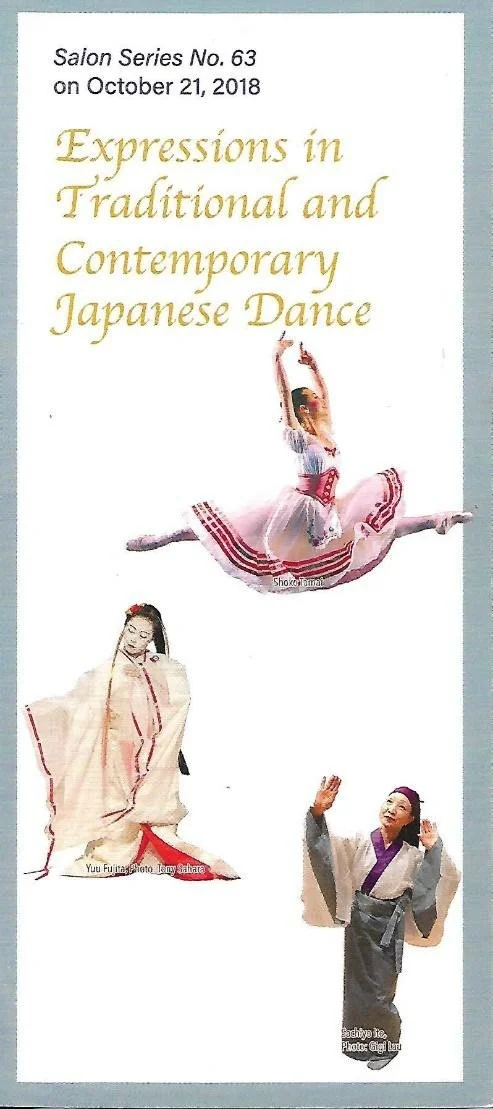
Continuing the exploration of traditional forms in dialogue with modern performing arts, Salon Series #63 featured a program centered on contemporary expressions in Japanese dance and ballet. Collaborating with Shoko Tamai, we explored the themes of Sky, Water, and Fire. The performance was accompanied by live music from composer and percussionist Yukio Tsuji—my longtime collaborator since the mid-1970s—and vocalist Beth Griffith, whose evocative voice, together with Yukio’s music, added depth and resonance to the program.
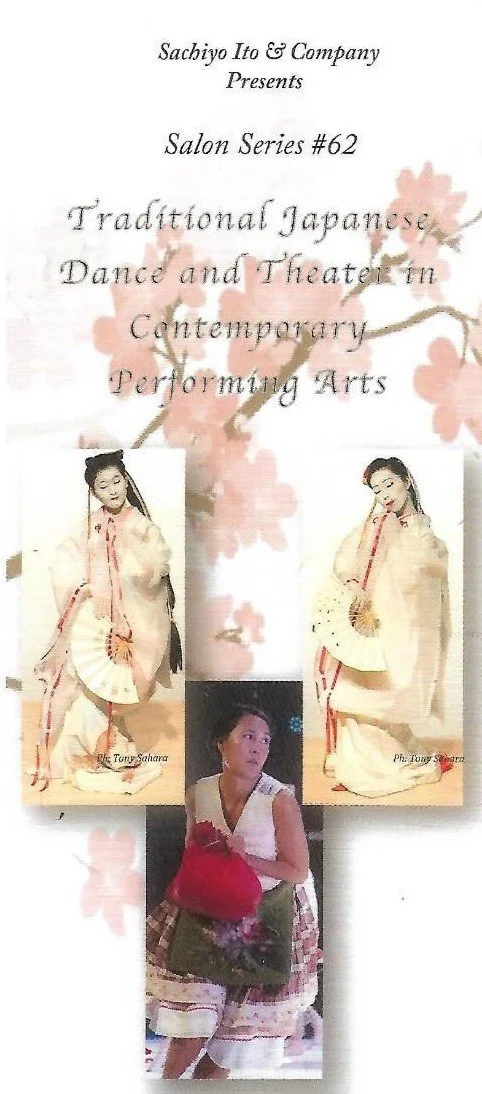
Salon Series #62: Traditional Japanese Dance and Theater in Contemporary Performing Arts
Collaboration with Guest Artists

Over the years, the Salon Series has evolved not only to highlight the differences and similarities among various dance cultures, but also to present creative collaborations with gifted guest artists from diverse backgrounds—making these elements a vital part of its programming.
The two collaborations with Rajika Puri, an Indian dancer, were an honor for me. As you can imagine, my guest artists had very busy schedules, so I was pleased that we could work out the performance with only two rehearsals. That program, Salon Series No. 37, was accompanied by traditional flutes of India and Japan, played by Steve Gorn and Ralph Samuelson respectively. We reversed the musical accompaniment of each country and danced to it. Both the audience and we performers enjoyed the switch. One of the most pleasing comments from the audience was, “I was blown away by how similar Indian dance and Japanese dance are!” Well, we paralleled our gestures and movements as they emerged and inspired others.
The comparative studies extended beyond Asia to include Spain and Russia.
Salon Series #37: Modernity in Tradition
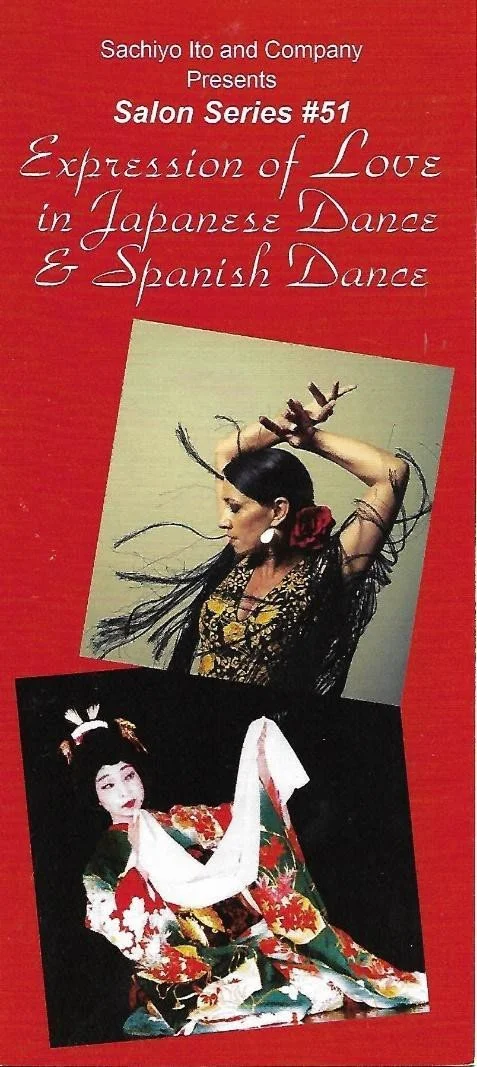
My longtime dream to work with Flamenco guitar came true in Salon Series No. 51: Expressions of Love in Japanese Dance and Spanish Dance. I loved performing with Juana Cala and dancing to the Flamenco guitar played by Jose Moreno. For our creation, we exchanged standard instruments: Her dance was accompanied by Shamisen, played by Sumie Kaneko, while mine was accompanied by Flamenco guitar. Each of us danced expressing love in our own tradition, but united happily at the end. Nodding to the musicians as I turned back, the signal for the musicians to move on to the last phrase of music and the dancers’ final steps and pause, was such a fun moment.
There was one thing I was quite worried about in presenting this program: the stage floor. Juana had great stamping power, and I feared that the gallery floor might be damaged. I was so worried about this that I increased my insurance premium. However, there was no damage after our performance, not even the slightest scar. To say I was very relieved would be an understatement.
Salon Series #51: Expression of Love in Japanese Dance and Spanish Dance
Walking
Recently, a friend’s family named their newborn son “Ayumu”. I thought, “What a wonderful name it is!” The word used for the boy’s name is the Japanese verb which means to walk, the same verb as “Aruku”. I could infer what the family wished for him: to grow up in good health, progressing little by little onward and forward.

In Salon Series No. 44: The Art of Walking, we explored walking—the fundamental aspect of dance, the very basics of dance—as manifested in three distinct styles: ballet, modern dance, and Japanese dance. We examined how and why each style approaches walking differently, shaped by cultural and social influences. I demonstrated how lowering and grounding the body’s center of gravity creates the signature gliding walk of Japanese dance. I then delved into the cultural reasoning behind these movements—insights familiar to dance and theater scholars, as well as ethnomusicologists in Japan, but often unknown to broader audiences. Among my favorite topics to share during school and cultural institution programs are the etymology of Japanese dance terms—mai, odori, and buyo, —along with reflections on the country’s insularity, geography, architecture, and agricultural traditions. But those stories are best saved for another chapter of my memoir.
As we all know, walking is the simplest, the most basic and fundamental movement in dance. In addition to being the physical foundation, it is also of great significance in delivering the message of the dance. It is such a simple movement, and yet, it is the hardest, which I find true in any art form and in anything we do in our lives. In Japanese dance, there is a saying: “After ten years, you start to walk properly.” Even at my age, after seventy years of dancing, I am still learning it. It is an art form, just as Gunji Masakatsu, the prolific writer and one of the greatest scholars on Japanese performing arts, pointed out. He called it Aruku-gei (the Art of Walking). In the dances Gion Shoja and Resonance, even though I was the one who choreographed them, the most difficult part was walking off stage at the end. However, I had to incorporate the exit walk into the choreography since it was essential in conveying the themes of those dances.
Dance has always been a metaphor for life for me. A dance can express our life events, our human emotions. Often it mirrors where we are in the stage of our life. In dance, we can show our life in a short time like a snapshot, condensing it or taking a single fragment. Walking in dance can serve that purpose well as: a distilled movement, showing the essence of dance and its message. In doing so, we also hope that the expression or message is not simply personal, but universal, showing emotions that we all share.
In our day-to-day life outside dance, our walk can also show how we are feeling, heavy on one day, light on another, and it exhibits how we hold our emotions both inwardly and outwardly as we trod on the path of our life.
Quite often, thinking about the miracle of walking leads me to think about the miracle of life. Taking a single step requires nerves, muscles, blood, and brain to function together miraculously. What a feat of coordination it is! Many speak of the miracle of Jesus walking on water, but I must say that even walking on the earth is a miracle. I used to observe my dog as he walked, following behind him, bending low to get the best view. I know it sounds funny, if you picture how I was following him, but the coordination of his four limbs is incredible.
I have had a fracture in my foot and knee injuries that have required surgeries. When such injuries and operations make us temporarily unable to walk, we realize how blessed we are to have the ability in the first place. Such experiences, along with passing by people on crutches or in wheelchairs, remind me of how precious the gift of walking is. Venerable Thich Nhat Hanh taught, “Walk on the earth as if you love the earth, since when you walk in anger, you spread anger.” His teaching shows us that love is so important to nature, both sentient and insentient beings, to others, and to oneself.
In the upcoming Chapter 16, I will talk about the Salon Series from a different perspective than in this chapter.
To read about two guest artists who stood out, Robert Lala and John Stevenson, please refer to Chapter 6 and Chapter 11, respectively.
End of Chapter 15
©Sachiyo Ito All Rights Reserved