
Chapter 14: Japanese Culture Through Dance II
For this chapter, I would like to share episodes and memories I treasure, which I encountered through my program Japanese Culture Through Dance.
Free Children’s Workshop
As a part of our community service for the city of New York over the past two decades, my company has offered free children’s workshops at schools and libraries and performances at geriatric centers.
One of the schools I cherish memories of visiting is P.S. 72 in the Bronx. The instructor in charge was Mrs. Sharon Williams, who was an incredibly passionate and loving dance teacher. Wholeheartedly she welcomed me and my program to introduce Japanese arts and culture to her young students. I must say the students were mirrors of their teacher: I have never met a class of students who were so affectionate, as if Ms. Williams’s beautiful personality, her passion, and love for dance and children were reflected on them. Even though it was the first time for my assistant Maiko and me to meet them, each one of them came up to hug us to show their appreciation at the end of the workshop. It goes without saying, their gestures and smiles touched our hearts deeply. I haven’t had such closeness and love from one-time workshop students though there have been countless schools and libraries that I have visited during the past 50 years. I went back to the schools to teach the following year, but the third time was not realized due to the pandemic.

One school that truly stands out in Brooklyn is P.S. 147 in Bushwick, which is home to a vibrant Japanese community. I had the wonderful opportunity to teach a class there for a few years that was made up entirely of Japanese and Japanese American students. At the time, I was still learning about the rich cultural diversity in the Brooklyn community, so discovering such a strong Japanese presence was both surprising and inspiring. I was especially fascinated to see that many of the students, though of Japanese heritage, did not speak the language — a beautiful reminder of how diverse and unique each student's background can be. It was an eye-opening and rewarding experience that deepened my appreciation for cultural identity and the many forms it can take.
For Free Children’s Workshop, I bring yukata and obi for the students to try on. This is always an exciting moment for the students, because almost everyone in the class volunteers to wear them. I also provide small dance fans decorated with the Japanese flag for the students to practice with, as seen in the photo of the Muscota New School below.

Muscota New School, Inwood, 2019
I am so pleased that learning dance movements and exploring different cultures can be a joyful and fulfilling experience, rather than just another school assignment. For me, it has been deeply gratifying to meet young people who are eager to learn about Japanese culture through dance.
Unfortunately, the pandemic has led to a drastic reduction in in-person workshops, even though both the teachers and I recognize how valuable human interaction is. Face-to-face communication with students is, in fact, one of the most essential aspects of education.
Giving my workshop at the Beginning with Children Charter School was a wonderful experience, and I visited the school repeatedly over 2018 and 2019. Not only did this provide my dancers and me with a wonderful opportunity to introduce Japanese culture and dance to the students, but it also connected me to Mr. Colin McNally, one of the teachers at the school. He had recently completed the “One Thousand Crane Project” with his students, folding a thousand paper cranes to benefit cancer survivors. I invited him to be a guest artist at one of my Salon Series programs in 2020, titled Prayer Through Symbolism of Crane.”

Beginning with Children Charter School, Brooklyn, 2019
As we know, the crane is a symbol of longevity and healing in Japan. In addition to performing dances in honor of victims of the pandemic, I talked about Sadako Sasaki, who died because of the atomic bombing of Hiroshima, and Mr. McNally explained his project and demonstrated how to fold origami cranes. At the end, Beth Griffith sang a touching rendition of “Amazing Grace” as a light to guide us toward healing.
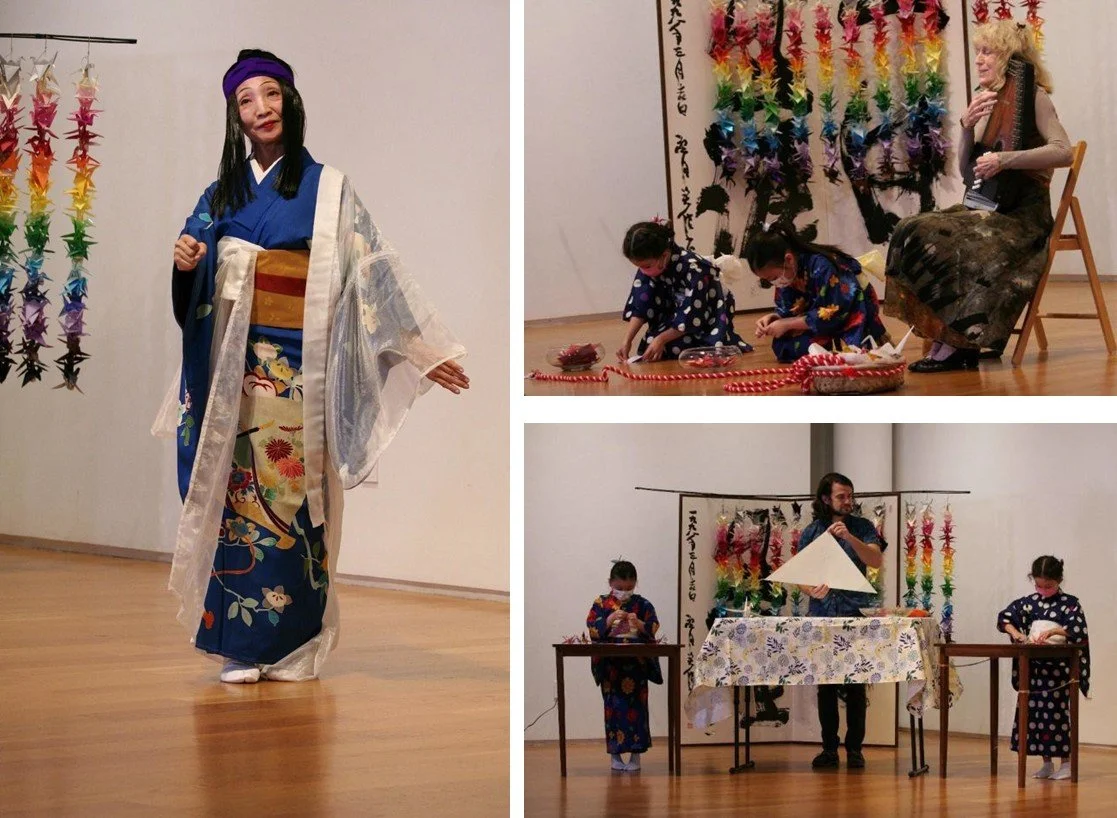
Salon Series No. 67, 2020
Flushing Queens Library
Among the many public libraries with which I have worked, I have had the longest association with the Flushing Queens Library. This relationship, which has spanned two decades, I owe to the dedication and efforts of Ms. Alexandra Sanchez, who promoted various cultures and their arts in the library’s international program. It is a relationship that continues to this day, even after Ms. Sanchez’s retirement. My company performed for 16 years in the library’s auditorium. After the pandemic, this program became a part of the Cultural Bridge program, presented in a hybrid format, in person and streaming. I have also worked with their children’s program several times over the years.
Our performances at the library opened another door for us. Patricia Welch, a professor at Hofstra University who was in the audience during one of our performances, made a dedicated effort to bring us to the university to perform, an opportunity we were able to take in 2016. I admired her perseverance in securing funding for our performance, which took a few years. We received very good responses and comments, even emails from students, faculty, and people from the area after the event of my lecture-demonstration and the company performance. Though we were appreciated and thanked for bringing Japanese culture to their Long Island community, the event could not have been realized without the efforts of many and their love for the Japanese culture and arts, something for which I am forever grateful. After the performance I bowed, not only to the audience, but also to all involved to have made our performance possible.
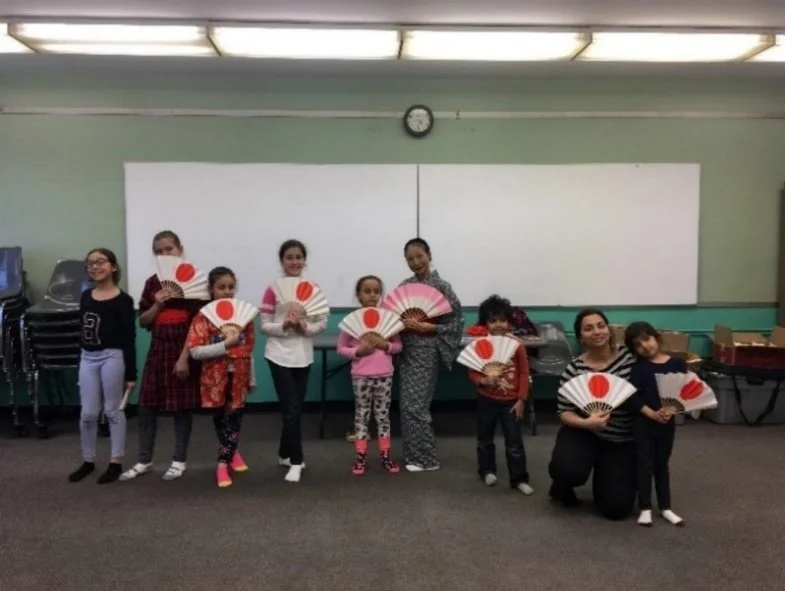
Children’s Workshop at Queens Library, 2017
Nightingale-Bamford School
I have always enjoyed working at the Nightingale-Bamford School, a private girls’ school. It was Ms. April Tonin, an art teacher and accomplished artist, who invited me to teach there over ten years ago. I taught the first graders, and I was consistently impressed by their excellent behavior and graceful manners, just as young ladies should display. They listened quietly and attentively to my presentations about Japan and followed my dance instructions with focus and enthusiasm. Their greetings in Japanese, their bright and intent eyes, and their warm smiles remain unforgettable.

Cotton Candy by April Kim Tonin
My company also performed for several of their school assembly programs. I will never forget their greeting to me: the entire school, nearly a hundred students, speaking in unison, “Good morning, Ms. Ito!” It is a memory I will always carry with me.
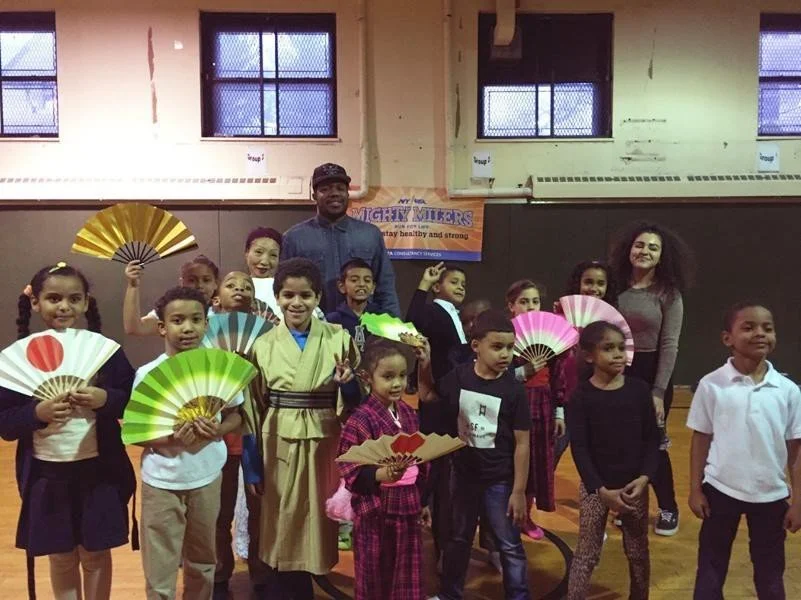
Kingsbridge Community Center, Bronx, 2017
Cultural Institutions
Aside from schools and libraries, I have collaborated with several cultural organizations to build bridges of art and culture among diverse communities.
One organization I worked closely with is the Center for Traditional Music and Dance, where our shared mission is to foster meaningful cultural exchange and artistic connection. My association with them began more than thirty years ago. The organization promotes ethnic music and dance traditions from cultures around the world, offering rosters of artists across multi-cultural and multi-disciplinary art forms. During the pandemic, I was deeply impressed by the initiative and resilience of the director, Andrew Colwell, who remained committed to the Center’s mission despite the challenges brought on by COVID-19. He proposed a three-month broadcast series titled Beat of the Boroughs: NYC, showcasing the work of diverse artists. I was honored to be among those invited to participate. The filming took place in my studio, and to be honest, I surprised myself, because it went so smoothly that we did not need any retakes.
Link: Beat of the Boroughs: NYC Online presents Sachiyo Ito
(https://www.youtube.com/watch?v=irGiG_aIh3E)
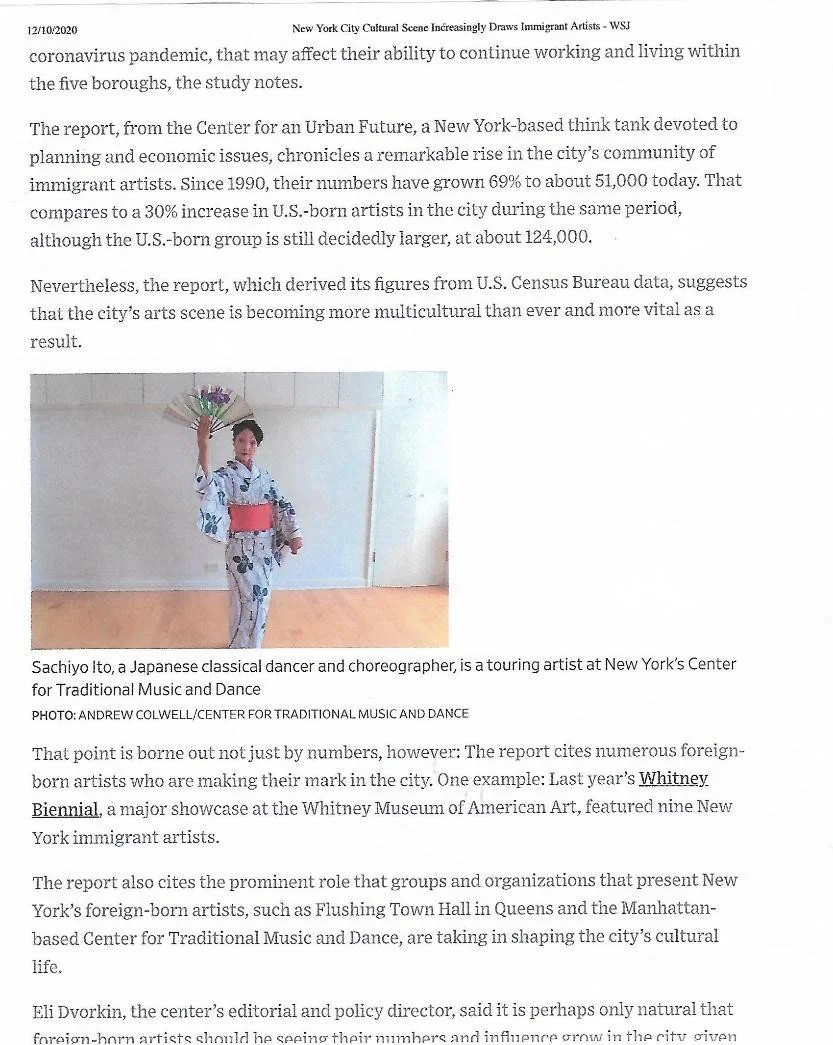
Wall Street Journal 2020: New York City Cultural Scene IncreasinglyDraws Immigrant Artists - WSJ
Japan Society

I have been involved with Japan Society since 1972, participating in a wide range of programs, including my own recitals, workshops, and lectures across the performing arts, education, and language departments. These programs have reached participants and audiences of all ages — from preschoolers and high school students to social studies teachers preparing to teach Japanese culture, as well as general audiences attending pre-performance lectures.
For young children, one special traditional occasion is Hina Matsuri (Dolls’ Festival), which celebrates the health and growth of young girls and is held on March 3rd. I was pleased to see many boys took part in my workshops, even though their own celebration, Kodomo no Hi (Chidren’s Day) is held on May 5th.
In Japan, these festivities reflect the cultural importance placed on the well-being and development of children. Traditionally, rather than celebrating each child’s individual birthday, the Japanese observed these days as collective birthday celebrations for all children. This was the custom I grew up with. However, as Western traditions have become more widespread, individual birthdays are now celebrated alongside the traditional holidays on March 3 and May 5.
As a child, I loved inviting friends over to celebrate Hina Matsuri. We would share special sweets in front of the display of dolls, which traditionally are passed down from grandmothers to mothers, and to their daughters. According to legend, the dolls must be tidied up and stored away promptly after the festivity. If they’re left out for more than a week, it is said the daughters will never marry. Maybe that is why I am still single?
Also, Young Audiences of NY and Midori & Friends gave me wonderful opportunities to offer Japanese dance workshops in various parts of New York City in the 1990s and 2000s.
Lincoln Center Institute for the Arts in Education
The passion and love for Japanese dance of the director of the Lincoln Center Institute for the Arts in Education still lives in my heart. I worked with the Institute for an entire year, culminating in the Tri-State School Tour held in the spring of 2000. The tour spanned over a month, and while I was not thrilled about the 6:00 a.m. call times required for consecutive weeks so that we could arrive early and prepare for each performance, it turned out to be nothing worth worrying about.
With a musician accompanying my dances and a young, cheerful stage manager by our side, our minivan felt like a throwback to my days touring in a station wagon with the AllNations Dance Company. The stage manager’s wild, purple-rainbow hair would lift around her head as she started the engine, and then our day would begin. It
was such fun.

Lincoln Center Institute for the Arts in Education Brochure
I truly appreciated having a stage manager who understood what was needed,—both in terms of logistics and school coordination. Normally, those responsibilities would fall to me, on top of performing. Her presence made my work—dancing and teaching students—so much easier.
Geriatric Centers
As I mentioned in the previous chapter, the original idea of Japanese Culture Through Dance was intended for youngsters, aiming to help them open their horizons and better understand other parts of the world. This is important work, as the world is becoming a global village, where people from different ethnic and cultural backgrounds interact on a regular basis.
However, as I gave workshops at geriatric and senior centers more and more often in recent years, I began to realize that speaking about cultures through dance is important not only for the young, but also for the elderly, for they can share their life experiences through watching and learning Japanese dance. Many times, in the facilities where we offer our programs, people happily told us their stories about Japan: visiting the country, their experiences of getting to know Japanese culture, and musings on their own cultures, stirred up by watching our dances. They showed their joy in being able to try some gestures with dance fans, even if they were in a wheelchair.
There are two geriatric centers where I have made repeated visits. The first is the Schervier Nursing Care Center in the Bronx, where on one occasion, my dancers were thrilled to be treated to a special Valentine lunch, while I was happy with the raised stage, well-suited for our performance, unlike small lunchrooms on most occasions.
The other is the Isabella Geriatric Center, where my longtime friend, former student, and volunteer Yachiyo Teramura was one of the audience members. She welcomed us with her usual big smile. Her appreciation for our dances was touching to me and my dancers, and our reunion brought us both to tears. I was so relieved that she moved away from the center before the pandemic hit. As we found out later, more than 90 residents there passed away due to COVID in the spring of 2020.
New York University
The first year I began teaching at the college level was 1975, at New York University. It was an assignment from the NYU School of Education, where I had finished my MA in dance. I was so happy to be called back by Dr. Patrica A. Rowe, the department chair. She was also my mentor in dance education. In later years, another great dance educator, Martha Hill, appointed me to teach dance at the Juilliard School.
I vividly remember the first week in New York after returning from Tokyo. Staying at the social welfare hotel was clearly a bad choice. I hadn’t expected it to be so dreadful: The hallway bathroom was too dirty for any decent human being to use, and there was a crazy lady who would bang on the bathtub at a certain time each night. The percussive noise accompanied by her screams, which made me feel even more miserable than I already was. Somehow, I had to pull myself together to teach.

The course I taught was titled “Japanese Culture and Dance,” and I would have about fifteen students. It was important for them to learn the history of Japanese performing arts, aesthetics, and the cultural background that nurtured our dance forms. I had brought dance fans and yukata back from Japan for them to use, but the yukata was too small for many of them, particularly the sleeve length. I told the students to add extra material to the sleeves so they could practice properly. I had already taught Western non-dancers in Tokyo; in comparison, this group of students seemed easier to teach. They had to have had previous dance training to be admitted to the dance department, just like the students at Juilliard, where I later taught. Many wrote very good term papers about Noh, Kabuki, and Nihon Buyo, which I held onto for a long time, as some of their writing and insights were incredible. Several became dance historians or critics in later years. Some kept studying with me and performed with me after they graduated. One of them, Jean Hurkin-Torres, studied with me from those NYU days until last year, when she moved to Vermont. She and I became close friends over the course of those 40 years.

My time as a professor at NYU lasted only eleven years. Toward the end of that time, I realized that I needed to dedicate time for finishing my research in Okinawa and writing my Ph.D. dissertation.
Although my days as a full professor are behind me, I have remained active in the collegiate world, giving performances, workshops, and lectures.
Giving workshops at Barnard College’s Theater Department has been particularly enjoyable for me because I have been able to meet many aspiring dancers, actors, and drama directors who are eager to learn the basics of Kabuki acting and dancing. One of the good things about the program is that it is open to students from both Barnard College and Columbia University. I am fortunate to have met Prof. Shayoni Mitra, who included me in her course, the World Theatre. She is keen for her students to have a real grasp of the Kabuki dance movement experience rather than just an intellectual and visual understanding. I did not mind at all purchasing and bringing dance fans back from Tokyo more than once. In recent years, I have been gearing the workshop toward the students’ experimenting and sharing their experience among themselves, which has shown to further their enthusiasm and energy.

I have given workshops through the Dance Department as well. I would love to continue offering workshops to the young dancers there, for I have found they are excellent dancers, and quick to pick up the techniques and styles of Japanese dance.

Speaking of Columbia College, I had a fortunate encounter with one of the students, Akin-san. As part of his credits, he took on the role of assistant to the artistic director (myself), a position made possible by his major in Japanese Studies, which allowed him to work with a non-profit organization like my dance company. Akin was incredibly intelligent, and always eager to help, even after his graduation. In 2015, he served as the head of the Japanese American Friends Club at Columbia University. After graduating with honors, he briefly worked at the Columbia library before heading to Japan to teach English at high schools in Chiba Prefecture. His contributions to my company were invaluable, and he even arranged for us to perform at the Friends Club. I still think fondly of him, the young man who was so passionate about both Japan and the Japanese culture, and perhaps he is still working and living in Japan.
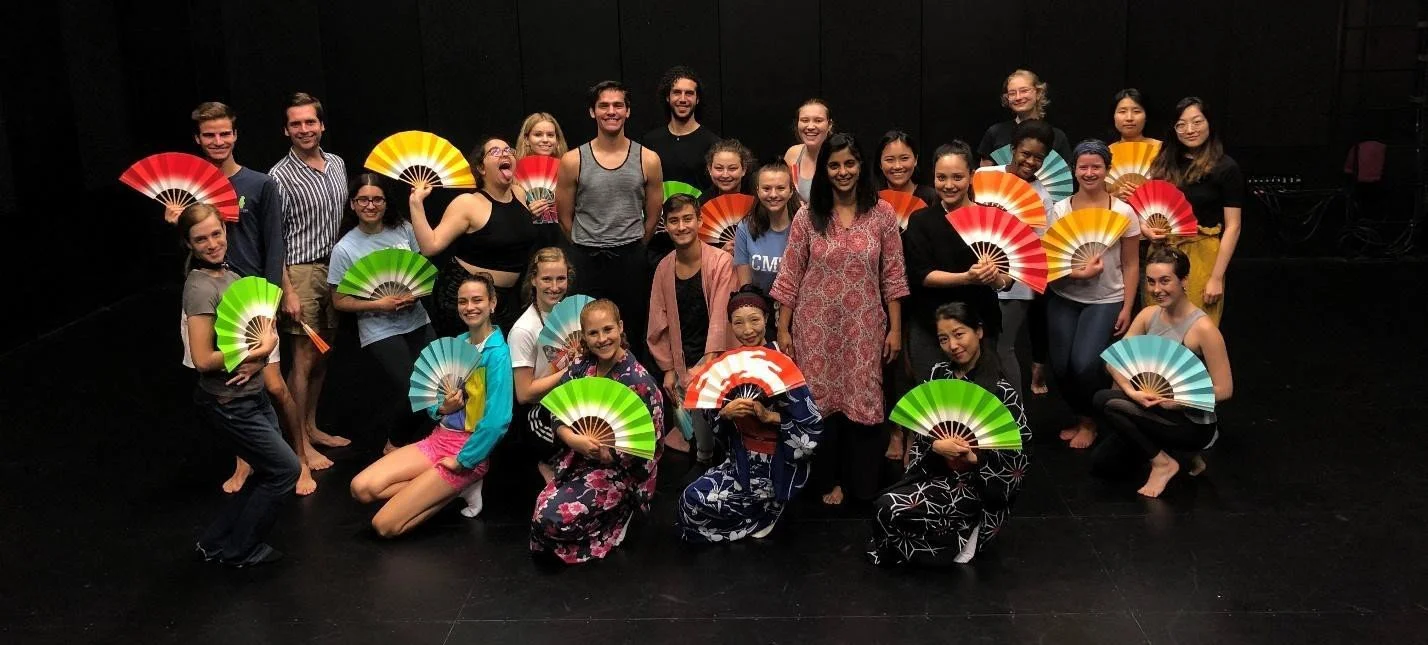
Barnard College Theater Department 2015 Class

Barnard College Dance Department 2023 Class
Stephens College
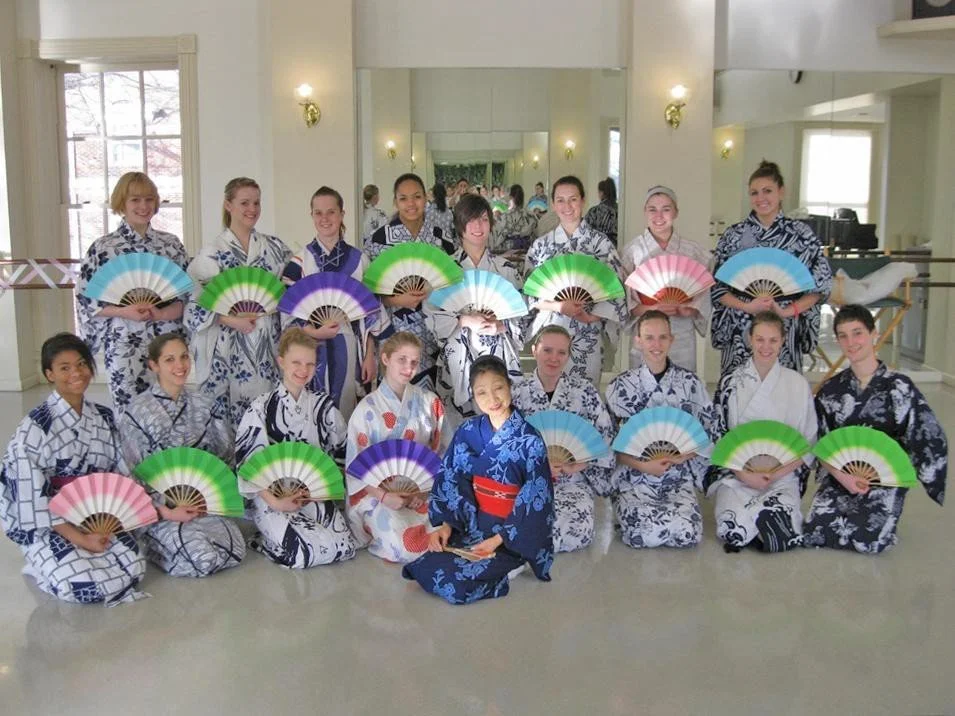

In 2009, I took a leave of absence from my New York studio for three months to teach at Stephens College in Columbia, Missouri. I was doubtful at first about leaving New York and the students in my studio. The short period away from them turned out to be a rewarding experience. I was particularly struck by the beauty of the Stephens campus, with its historic buildings and the stunning dance studio within the expansive grounds. I was very fortunate to visit in the fall, when the entire campus was wrapped in vibrant autumn colors.

There is a photo from my time there in the Columbia Missourian that I love: it features all of us in class walking forward and in doing so, captures one of the most important basics of Japanese dance. It was very easy and enjoyable to teach these aspiring students, who were all eager to take up professions in the performing arts. All of them were excellent dancers, having made it through rounds of auditions to be admitted to a department known for its high standards. They were very quick to follow my instructions and were always ready to start class promptly, already dressed in yukata. We held another audition for a production for which I would create new choreography. The students who were chosen to perform were truly top notch. I cannot express enough how much I enjoyed working with these students, regardless of whether they were trained in modern dance or ballet. The new work, titled Just Like Birds and set to a modern Koto composed by Tadao Sawai, was a joy to choreograph.
One big surprise I received was the gift of a large photograph of me in Mitsumen Komori, taken in the early 1980s as a promotional photo for Asia Society. The photographer, David Fuller, had a friend who worked at Stephens in administration, and on hearing that I was coming, prepared the special photo for me.

Mitsumen Komori Photo by David Fuller
Another surprise occurred much later, when I met two of the young men I had taught at Stephens College at a rehearsal space in New York. They had both come to the city and joined professional dance company after graduation. It was such a delight to see them again, particularly knowing that they had kept pursuing their careers and continued to dance.
Teaching is a Blessing
Teaching has gifted me countless lessons, but one of the most profound insights echoes the wisdom of our predecessors—from Plato to Socrates and many others: “I know that I know nothing.”
The longer I teach dance, the more I realize how little I know about the art. Dance is far more than steps, movements, and technique. It carries the weight of culture—its history, its stories—all distilled into fleeting, beautiful moments on stage.
Looking back, I feel a sense of humility. I began teaching at a young age, with only a limited understanding of dance. While I could instruct technique and repertoire, there was so much more I should have been passing on to my students. Over the past 50 years, I have deepened my understanding of my heritage and the roots of the Japanese culture that shaped our dance traditions. Yet even after five decades, I know I still have so much more to learn.
I suppose this realization is true for any artist: the longer you toil in your life’s work, going deeper into the truth of art, only to realize that you have just touched the tip of the iceberg. So, I often find myself sighing as I face the immensity of traditions. But still, I want to share it, offering my limited resources in whatever capacity I can to my students. In return, my students have given me the precious gift of their curiosity and questions, leading me to look at dance from different angles and see it in a new light, helping me to grow as both a teacher and an artist.
I did not always look at teaching this way. There was a point in my life when I envied artist friends who did not have to teach; I would have preferred to concentrate on my own choreography and performance, as they did. However, I was wrong. For over time, I realized how much teaching was deepening my own performance. Teaching provides the ability to reach a new angle of choreography, of technique, of dance itself. Learning through teaching is a priceless gift, and it has become my nourishment, bone, and blood: a great blessing.
My program, Japanese Culture Through Dance, expanded over the decades in ways I could not have imagined when I started it. What began as a local program for children grew into something encompassing all ages which took me to many different parts of America. It has provided me with irreplaceable and precious opportunities and experiences. Although one would assume that the recipients of the workshops and classes are the beneficiaries of my teaching, I think that it is the opposite: I am the one who has received the countless benefits of learning and beautiful gifts to treasure.
Affirming that learning art enriches our lives, regardless of whether one aspires to or succeeds in becoming an artist or not, the joy of discovery and the insights we shared together in class become the nourishment for all participants—students and teachers alike. This in turn has become my own engine, the force that propels me forward in life, the only life I was given on this earth. Humbled, I can only vow to continue spreading the beauty of Japanese arts and culture.
End of Chapter 14
©Sachiyo Ito All Rights Reserved