
Chapter 11: Poetry in Motion for the Time of Contemplation
Please Call Me by My True Names
The bright morning sunlight during the walking meditation along the cliff over the Pacific Ocean was sublimely beautiful. In my mind’s eye, I can still look up at Reverand Hanh’s face as we walked up the hill, the brilliant sun shining behind him. Nowadays, this image returns to me on my morning walks with Joy, my dog. I must say it was the stroke of luck of a lifetime that I was able to meet Thich Nhat Hanh, Zen monk, poet, and peace activist-recommended for a Nobel Peace Prize by Martin Luther King Jr. in 1967 and get to know his teachings.
My first retreat with Thich Nhat Hanh and his sangha took place in 1990 at the University of California, Santa Barbara. Though I am not a Buddhist, his teachings and poetry have profoundly shaped my artistic journey. It was through his influence that I began choreographing dances inspired by poetry—a practice I embraced from that moment forward.
During the retreat, I also had the privilege of meeting Sister Chan Khong, a longtime collaborator of Reverend Hanh. With great generosity, she made time to meet with me, allowing me to share my choreographed dances and seek her blessing to present them publicly. I was deeply grateful when she granted that permission.
I presented dances based on Rev. Hanh’s poems for the first time at my concert, titled, “Dedicated to World Peace” in 1991 at the Clark Studio Theater at Lincoln Center.
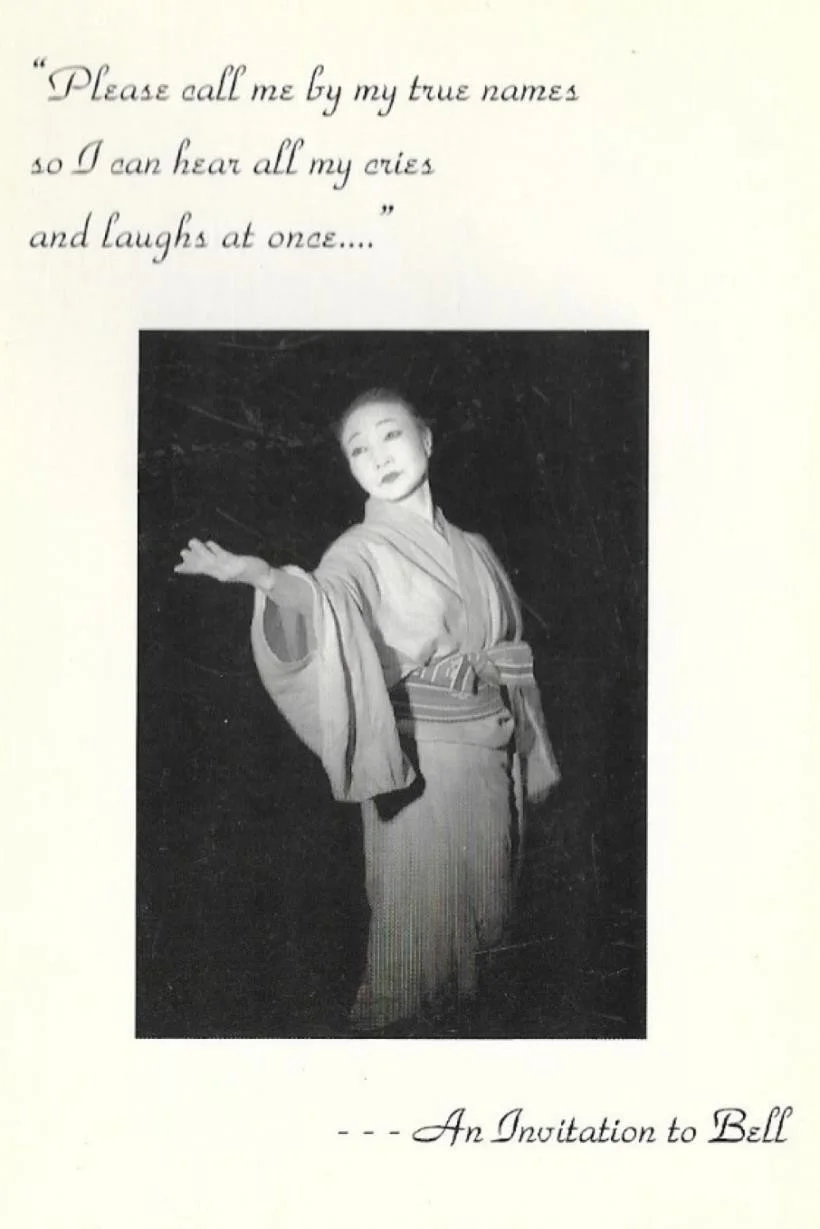
The main poem I choreographed for this concert was Please Call Me by My True Names, which appeals to the interconnectedness of all beings, both sentient and insentient. I titled my dance, though, An Invitation to Bell. The title may sound strange, but my intention was to ring the bell in a gentle manner, rather than by striking it, and to invite people to listen to the sound of the bell. The bell would signal the start of interactive walking meditation, a time for us to pause and focus on breathing.
Through audience participation in the walking meditation, I hoped that Thich Nhat Hanh's call for humanism would be heard and felt. I titled the concert Dedicated to the World Peace to reflect Hanh’s message calling for compassion, reconciliation, and inner harmony, and held it on the weekend celebrating Martin Luther King Jr., who supported Hanh’s work.
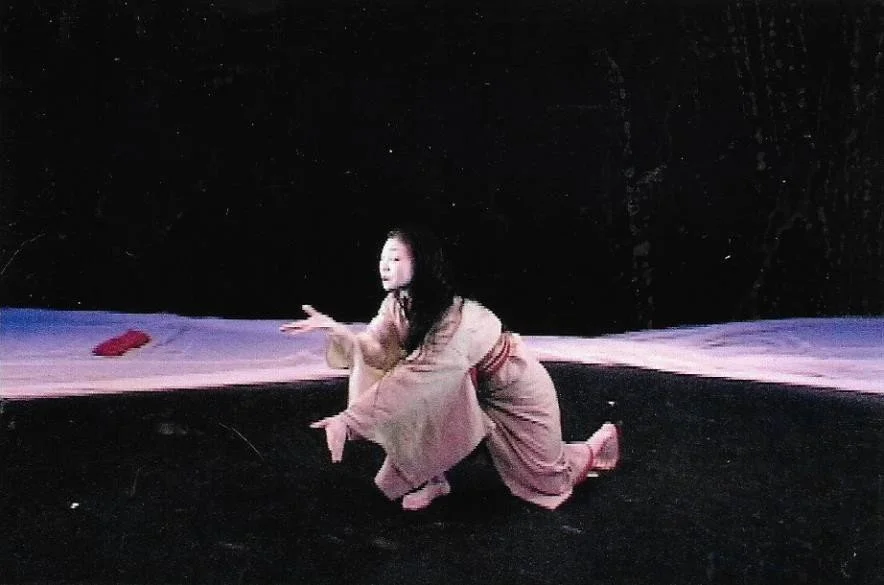
Photo by Reiko Kawashima
Although the concert’s theme was vast and global, one small, human moment remains etched in my memory. The Clark Studio Theater, intimate with its 100-seat capacity yet impressively outfitted with lighting and a soaring ceiling, became the perfect setting for a touch of magic. It was there that set designer Bob Mitchell’s shimmering ball descended gently into my hand during the piece Moon Child—a moment of quiet wonder.
For Please Call Me by My True Names, the stage demanded a more ambitious setup. I transported bamboo poles over eight feet long, meant to suspend scrims both horizontally and vertically across the stage. Carrying them from the shop to the theater—gripping them with my hands and balancing them across my shoulders—was a journey in itself. Somehow, I even managed to maneuver them into a subway car, much to the surprise of fellow passengers.
Looking back, I wonder if the pursuit of world peace was too grand a vision for a minor dancer to advocate. But perhaps it’s in these small, determined gestures that the spirit of peace quietly begins.
Spoken Poetry
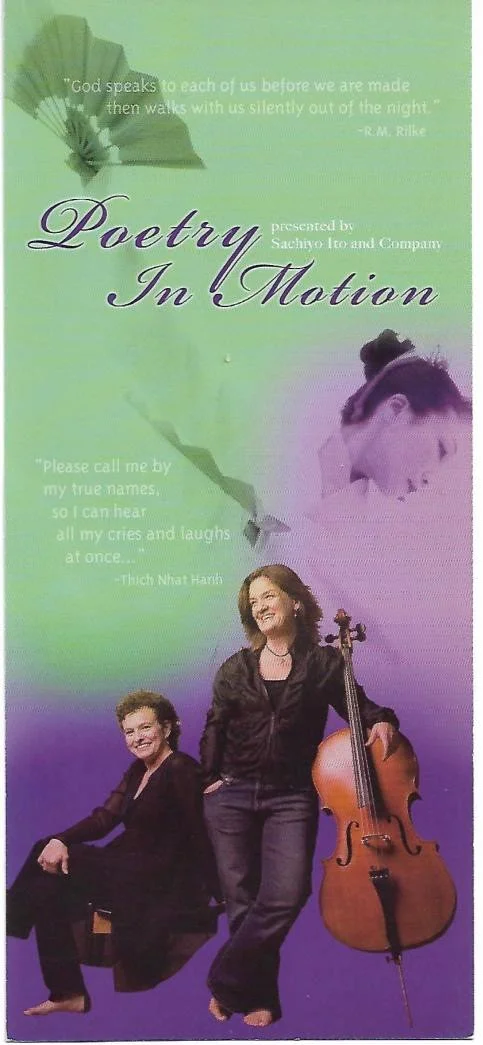
Then, in early 2010s I had the good fortune to meet Kim Rosen, who performs “spoken word poetry”, and Jami Sieber, a cellist, and collaborate with them for the 15th Anniversary Concert of Salon Series in 2013. I met them at one of the retreats they were offering, and a few years later I invited them to the concert. Luckily, they were able to combine an East Coast visit with their tour schedule and were able to participate.
I was used to poems being referred to as “recitations”, when spoken aloud. Kim did not call her work “recited,” but rather “spoken”, “spoken poetry.” She would memorize poems and speak in a very moving manner, often powerful enough to send us listeners into tears. With Jami’s cello providing beautiful accompaniment, Kim’s speaking was deeply touching. Together, they offer workshops for healing around the country, and overseas.
Thereafter, I presented a series of choreographies to recited or spoken poems.
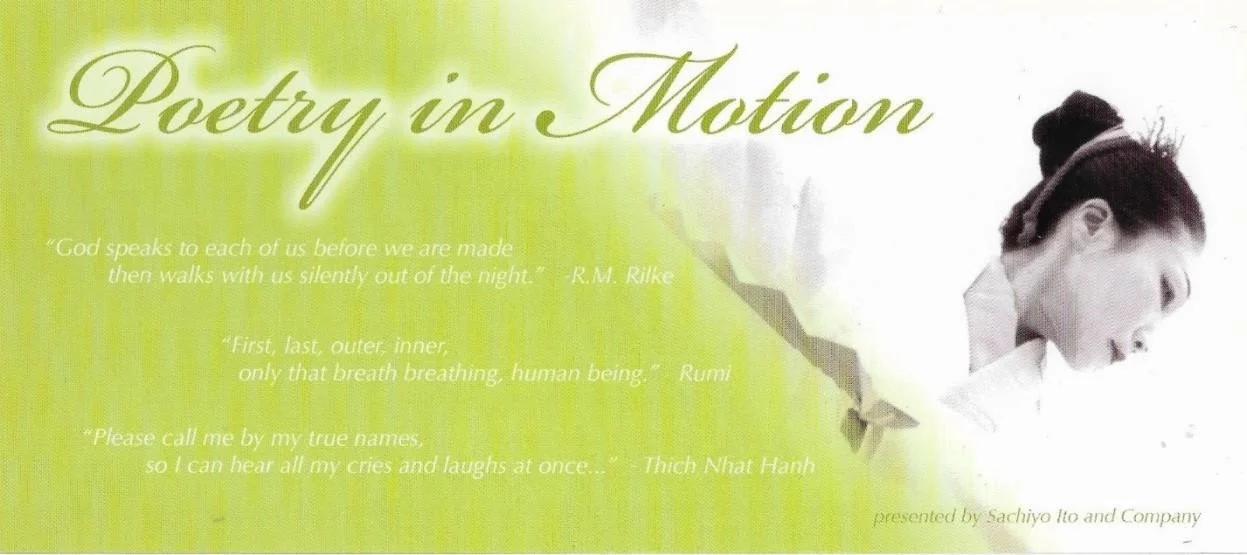
In 2010, I presented the concert Poetry in Motion at Joyce Soho, based on poetry not only by Thích Nhất Hạnh, but also by Pablo Neruda, Mary Oliver, Rainer Maria Rilke, and Rumi. These dances were accompanied by percussionists Yukio Tsuji and Egil Rostad. Singers Beth Griffith and Elizabeth Knauer performed the poems, including my favorite, Chieko-sho, which you may remember from previous chapters. The poem Only Breath by Rumi inspired me to create a cross-cultural work, where the human spirit gathers as one. Different ethnic dance forms represented cultures across the world, including Indian, Russian, ballet, and contemporary dance. To represent Japan, I chose a karate master, Tokumitsu Shibata, who impressed both artists and the audience as he combined karate with my choreographed movements so well that it was simply amazing. The concert was one of the most exciting collaborations I have had.
Renku and Dance
Inspired by the teachings and poetry of Reverand Hanh, I embarked on a creative journey that wove together poetry, walking meditation, and dance. Walking meditation, with its emphasis on quieting and focusing the mind, supports both the composition of poetry and the creation of dance. Drawn particularly to the haiku form, I began leading workshops that integrated these practices at spiritual retreats, including those held at Dai Bosatsu Zendo.
The most memorable venue where I gave this workshop was the Morikami Museum and Japanese Gardens in Florida, where I had been previously invited to perform Japanese dance at local art galleries as well as at Delray College.
Ito danced to a haiku written by suburban Delray Beach resident Douglas Davy. "She was very deliberate," he said. "You could watch a performance, but it's taking something written and interpreting it… It was extraordinary."
- Michelle Mundy, The Palm Beach Post, March 8, 2002
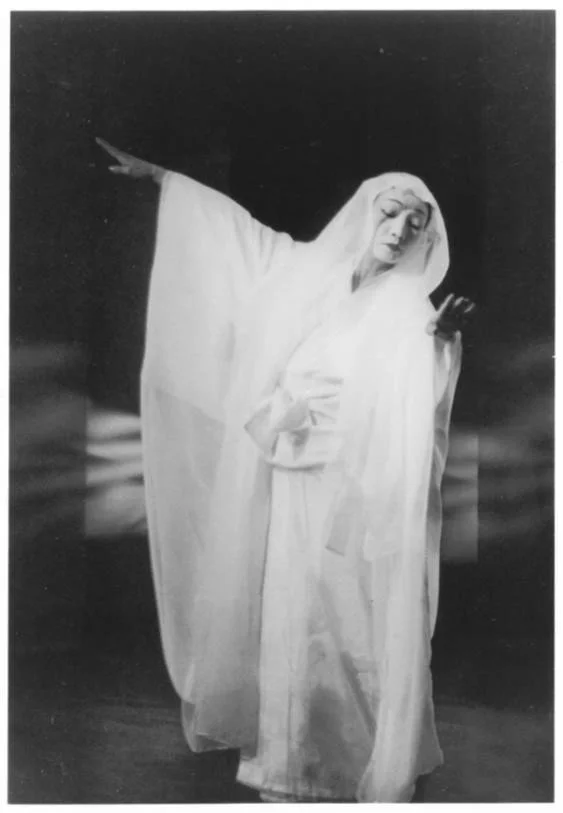
Photo by Reiko Kawashima
By my third visit in 2002, the Morikami Museum had been beautifully renovated, including the addition of a Japanese garden. My program was titled “Walking Meditation, Poetry, and Dance.” I conducted the walking meditation for participants, beginning in the auditorium, then continuing into the outdoors and around the garden; this stroll would serve as the basis for the haiku -composed later. Upon returning to the theater in the museum, I improvised dances to the haiku stanzas presented by the audience. The pine trees in the Japanese garden were just as magnificent as those we see in Japan, and proved to be very inspiring for the composition of haiku. The breeze through the pines was so lovely that it brought to mind the line, “Rustles of the wind, or whispers of the pines…” from the Noh play Matsukaze (Pine Wind).
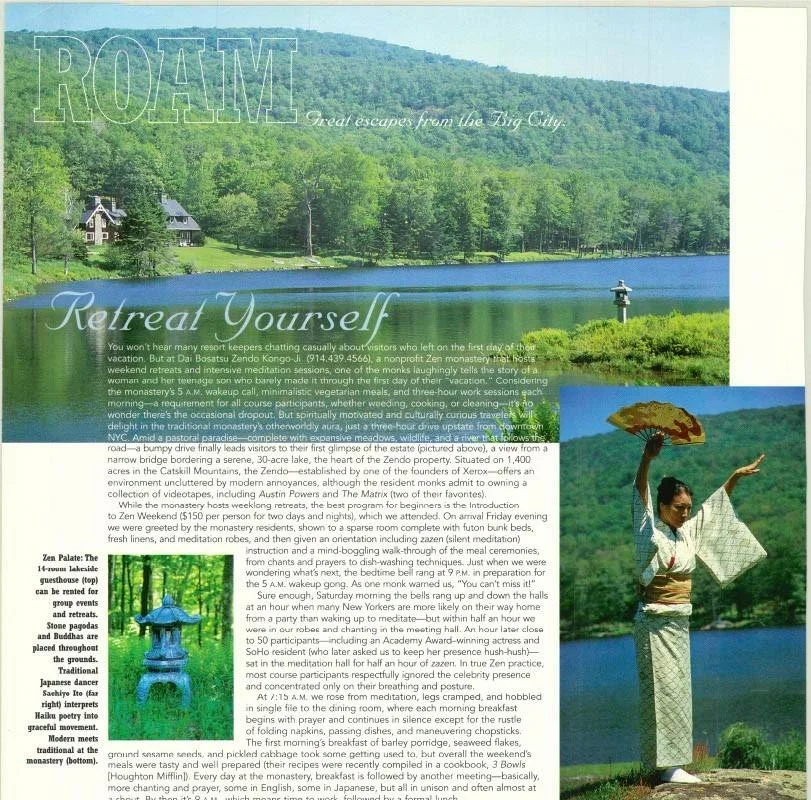
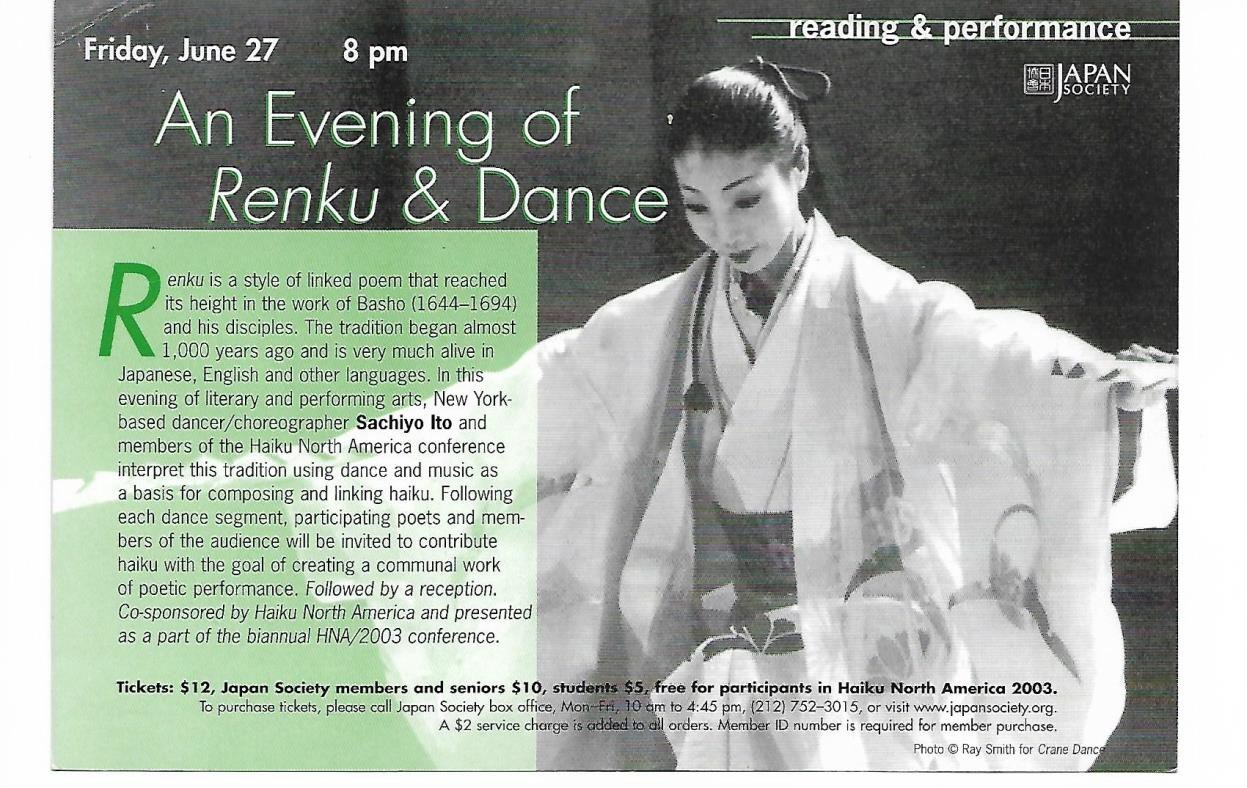
In 2003, the program An Evening of Renku and Dance (Linked Verses, and Dance), held at Japan Society in collaboration with the Northwest Conference of Haiku Society of America, was the beginning of my collaboration with Haiku Society of America. Six poets, along with three musicians and I, were on stage, ready to improvise on whatever haiku the poets might compose. We concluded the program with a haiku from a member of the audience. It was a humorous one, written by a lady from India, about a bug in the head! And so, my dance was humorous as well. After the performance, she gave me a beautiful red silk Indian scarf, a gift I cherished for many years. I was happy and perhaps a little relieved as the program ended with a lot of smiles.
The collaboration with Haiku Society of America did not end with the Japan Society concert in 2003, but continued through 2023 in my Salon Series, led by Penny Harter, John Stevenson, and the late William Higginson.
To collaborate with me on linking verses and dances requires the ability to write haiku on the spur of the moment while watching my dance. For this improvisation of dance and poetic verses or stanzas, spontaneity is the essence of the endeavor, rather than contemplation. It requires a genius to write a stanza on the spot, making a quick decision on the choice of words upon observation of the dance. I must bow to all three poets, who so effortlessly showcased this skill. Bill was a prolific writer, instrumental in introducing haiku to the Western world, while his wife, Penny, was more than a haiku poet (if you say she was more than a haiku poet, add what “the more” is). Although their artistry is unbelievably prestigious, they were incredibly kind and generous in supporting my work and collaborating with me on Renku and Dance in my Salon Series. As for John, he has worked with me all these years, as a partner in words and footsteps. My gratitude to him and my respect for his haiku and scholarship as a writer, thinker, and poet is more than I can express. His haiku is often humorous, yet it has a deep, humane touch.
His essay in the Salon Series No. 54 Yoin: Resonance in Japanese Music, Dance, and Literature on the theme of resonance was incredibly insightful:
“There is no meaning to light without darkness, no meaning to darkness without light. Conflict, however, is not the only way of looking at these mutually dependent aspects of reality. A great deal of their interaction is characterized by harmony and resonance.”
One of my favorite haiku by John, chosen from among far too many, is:
A deep gorge...
Some of the silence
is me
- John Stevenson Geppo, July/August 1996
To join my programs, John would gather his friends from the Haiku Society of America, making the journey from his home in Ithaca by train just for the day. Thanks to his kindness and dedication, our Renku and Dance collaborations became a recurring feature throughout the decades-long Salon Series and were even highlighted in its finale. I was deeply grateful that John was able to join us for that final program, for his presence made the closing all the more meaningful.
Renku and Dance inspired my workshop Dance and Poetry of Japan, held at senior centers in Chelsea, West Village, and the Lower Eastside in New York. Participated in by seniors who love poetry and Japanese arts and culture, the program has been repeated for the past 10 years. The seniors are great composers of haiku, and they happily meet the challenge to make Japanese dances based on haiku and renku. Together, we share our life stories, inspired by our poetry composing process and dancing. We converse about our histories, the countries we come from, and through the poetry we create, we find ties that connect us across ethnicity and culture, rather than boundaries that separate us. Together, we come up with new dances to illustrate our poems.
Watching the seniors learn new forms of dance is simply amazing. I call them seniors, but their interest and curiosity keep them young at heart, which is a valuable lesson for us all. The ephemeral quality that is shared by poetry and dance, particularly Japanese dance with its subtle evocativeness and suggestiveness, gives us a vast possibility of expression, of ways to tell the stories of our lives. It is something I am thankful for having discovered in my life.
Listening to Sand pouring sand
from one palm to the other— she listens foam slips
from a clam shell, sand draining with it carried out above
the sea, sand drops from a gull's cry
at the sea's edge her feet slap the sand-breaking waves listening to sand she remembers night wind—
dune grasses yielding
- Penny Harter for Sachiyo Ito,
written during her dance to "Chieko: The Elements" (Chieko: Genso)
Copyright © 2008 Penny Harter
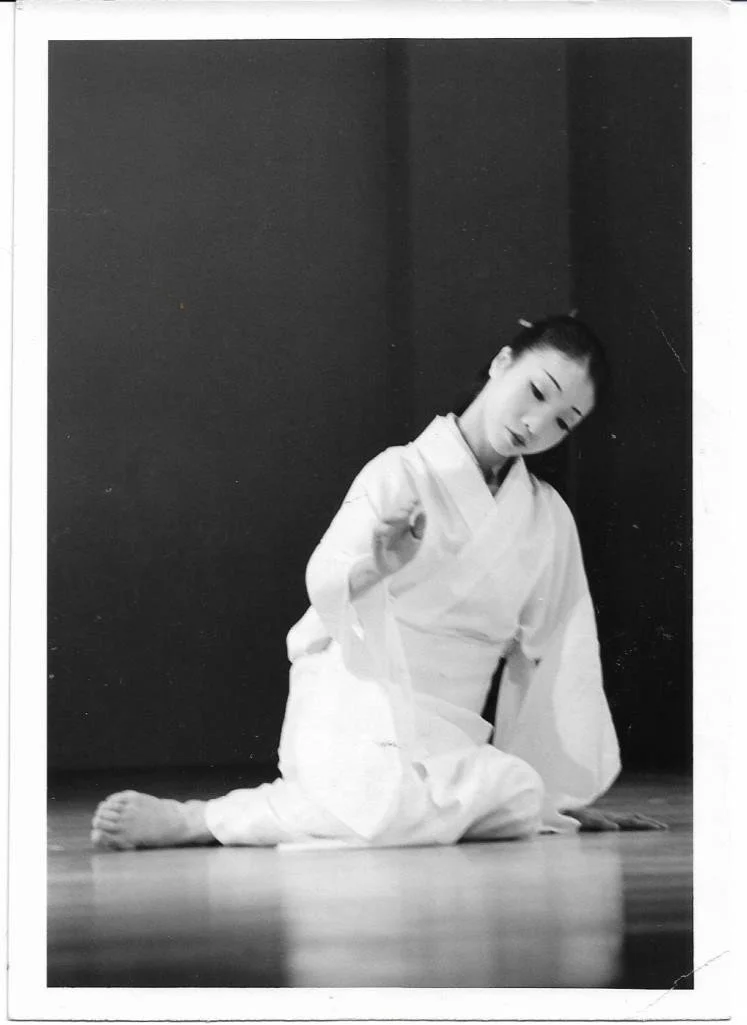
Chieko Genso (Chieko The Elements) Photo by Ray Smith
End of Chapter 11
©Sachiyo Ito All Rights Reserved