
Chapter 13: New Year’s Greeting
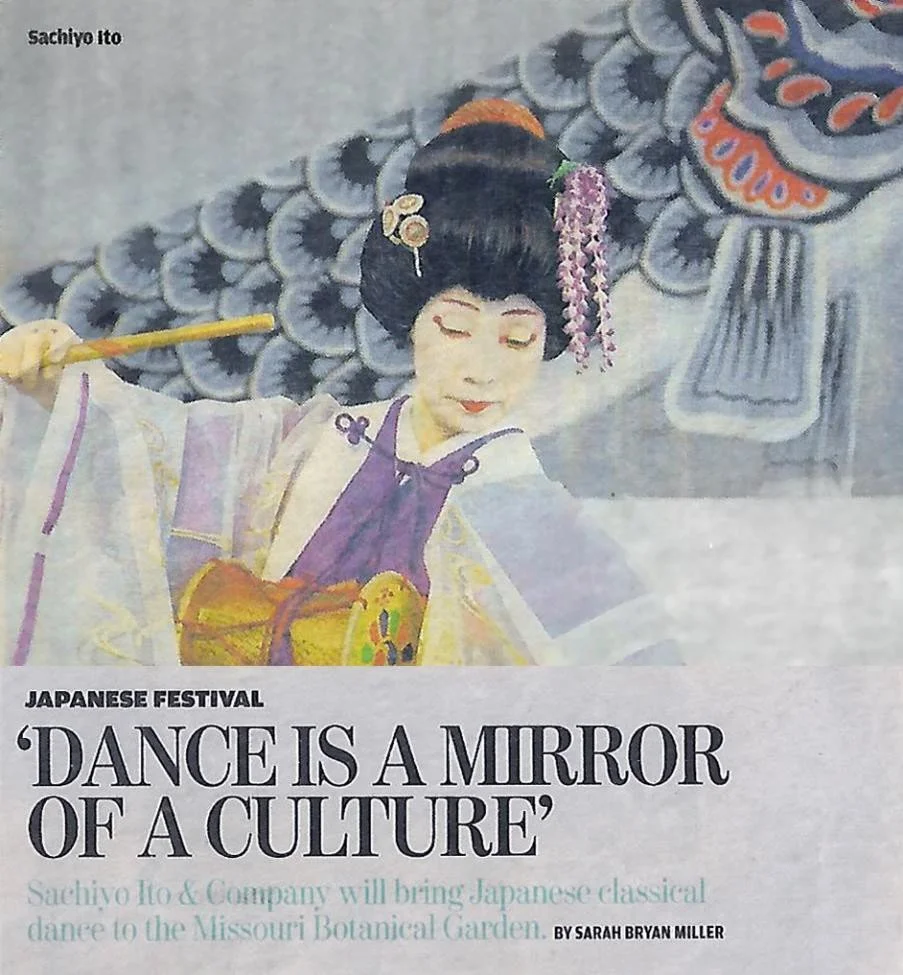
St Louis Post-Dispatch 8.29.2014-9.04.2014
“NIHON BUYO - DANCE IS A MIRR NTO JAPANESE CULTURE: Japanese Dance: Looking into Japanese Culture…
In addition to viewing Japanese culture through the lens of dance, observers and dancers also learn about themselves and apply the valuable lessons learned on the dance floor to their own, everyday, modern lives.”
Lisa Birzen, Chopsticks Magazine, October 2009
Happy New Year!
May your 2025 be beautiful, creative, and healthy!
The 12th Chapter was about reflections and mirrors, and now in this chapter I would like to continue exploring the theme of “mirroring.”
Also, being the beginning of the year, let me also talk as well about my dance school’s “Odori-zome” (The First Dance of the Year), which we consider as our New Year Greeting, also and about the significance of the greeting gesture, bowing in dance.
The phrase “dance is a mirror” has been the backbone of the philosophy behind my teaching and performance for the past fifty-five years in Japan and the world outside of it.
Dance is a mirror. It reflects the culture that nurtures it. Every facet of a society-its history, literature, social customs, geography, climate, and racial makeup—shapes the dance forms that emerge from it. These art forms are born within specific cultural contexts and are passed down through generations, carrying the essence of their origins. Dance also serves as a powerful means of communication, transcending barriers of language, ethnicity, and cultural differences to connect people on a deeper level.
With the hope of helping students understand Japanese culture through traditional dance, I developed a program called Japanese Culture through Dance, designed for schools and cultural institutions. I have always believed that dance is a vital tool for young learners to broaden their horizons and deepen their appreciation of diverse cultures by engaging with traditional forms, styles, and techniques. Ultimately, my goal is for students to reflect on the meaning of their own cultural art forms in comparison to what they experience in our workshops and classes. Ideally, these educational encounters will inspire their future creative lives.
Dance/NYC stated the role of dance eloquently in its August 2024 post.
“Dance is not just an art form; it is a powerful means of expression, connection, and transformation. It bridges cultural divides, fosters empathy, and brings people together in a shared experience of joy and creativity…Dance has the unique ability to tell stories that words cannot fully capture.”
Japanese Culture through Dance has come to be known as the “Free Children’s Workshop” when it is offered in libraries, schools, and cultural institutions. Initially, I believed this program was meant solely for young people—to broaden their horizons, introduce them to diverse cultures, and help them better understand others in their communities who come from different backgrounds. However, after increasingly offering workshops in senior and geriatric centers in recent years, I’ve come to realize that sharing culture through dance holds deep value for older adults as well. Not only does it allow them to engage with and learn about another culture, but it also opens a space for them to reflect on and share their own life stories. Many seniors who participated in our workshops joyfully recounted personal memories stirred up by the experience of dancing Japanese dances—memories that, in turn, sparked reflections on their own cultural heritage and its unexpected connections to Japanese traditions.
Given that New York City is a vibrant melting pot of cultures, my dancers and I were thrilled to participate in the 2008 concert series Waves of Traditions, held at Brookfield Place—formerly known as the World Financial Center. This special event celebrated the rich diversity of ethnicities and cultural traditions that make up the fabric of New York. Our two performances for this concert series were wonderful opportunities to share our repertoire of Japanese dance, set against the stunning backdrop of the Hudson River.
Many audience members joined us during their lunch break, while shopping, or after work, creating a lively and spontaneous atmosphere. Dancing in the second rotunda overlooking the Hudson was a truly beautiful experience. I will never forget watching the sunset through the windows as we packed away our costumes and props-it was a moment of quiet reflection after a day of joyful performance.
That evening brought back memories of a performance I gave years earlier at Windows on the World, the exclusive club and dining room atop the World Trade Center. The view from there was one of the most breathtaking I have ever seen, and its memory has become even more poignant in the wake of the devastation and loss of 9/11.
As I reflect on the makeup of my dance students, I am struck by the changes I have witnessed over the years—different populations flowing in and out like waves. I still remember my surprise in the late ’90s when emerging Japanese hip-hop dancers began winning awards at competitions like the one at the Apollo Theater. From energetic hip-hop dancers in their 20s and 30s, to aspiring Broadway performers, to Japanese artists who traveled from overseas with dreams of becoming professionals, my studio has welcomed individuals from all walks of life. Their determination reminded me of my own youth, when surviving in New York—both in pursuit of artistic goals and in daily life—was no easy feat.
Broadway was becoming increasingly appealing to Japanese performers, yet many of them also recognized the importance of staying connected to their cultural and traditional roots. I was deeply pleased when they chose to study Japanese dance, hoping it would enrich their creative journeys. Some were so committed that they eventually became core members of my dance company.
Over time, I have seen a noticeable shift in the age of my students. In the early 2000s, children as young as three came to study with me, often at the urging of parents who wanted them to learn about their heritage. Today, however, my classes and workshops are attended more by seniors than by children.
Since the pandemic, there has been a significant decline in the migration of young artists from Japan. By contrast, workshops at senior centers in New York City—both virtual during Covid and in-person afterward—have grown in prominence, reflecting a broader societal shift.
I miss so much the workshops for children, especially now that schools and libraries where I used to teach seem to place less emphasis on artist-led, interactive learning. I have always believed that hand-to-hand and eye-to-eye contact in teaching is irreplaceable—there’s a kind of magic in the direct exchange between teacher and student that technology simply cannot replicate. Of course, I understand that educators have had to prioritize digital tools and tablet-based learning in the wake of the pandemic. But precisely because of this shift, I believe the arts are more vital than ever. They offer a vital counterbalance to the isolating nature of tablet-based education, helping young people reconnect with themselves and others. In our increasingly AI-driven world, the arts affirm and nurture what is uniquely human—and profoundly humane.
Odori-zome
At the beginning of each year, I hold an Odori-zome. This event has been held for the past 25 years at Tenri Cultural Institute. The literal translation of the word “Odori-zome” is “to dance for the first time in the New Year,” and with this performance, we vow to study harder in the coming year. A similar word is used in calligraphy also, as in Kaki-zome (Writing for the first time). This is the time for students to show the fruits of their studies over the previous year, and I find much pleasure in watching their progress and seeing their improvement year by year.
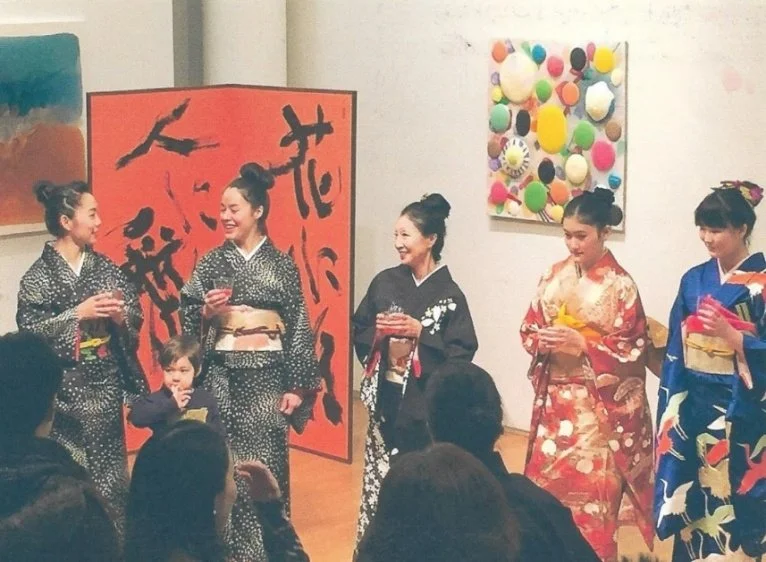
My students strive to demonstrate their best stage presence in this small public performance for friends and families. Some guests find it interesting to see my students’ various nationalities, as we are an international group, composed of people from different ethnic backgrounds who love Japanese culture: Chinese, European, Americans of all colors and creeds, as well as Japanese. I am so pleased that they experience no boundaries in their aspiration and love for Japanese culture and the arts.
As the Odori-zome is a significant event, the students must dress themselves in formal kimono. This poses a special challenge, as they are used to dressing in just a simple yukata during lessons. However, this special occasion motivates them to learn, often from video tutorials found online. I only help them a few times through teaching but emphasize that it is important to practice dressing on their own. If we are dependent on someone to help us, like professional kimono dressers, we will never become better at dressing ourselves. This is a valuable lesson for other areas of our life: You must do it as you got to do it! And you can do it.

Odori-zome (New Year Dance) 2015
Dressing for the Odori-zome is also a great opportunity to appreciate the beauty of the various types of kimono, such as tomesode and homongi, and the beautiful belts worn with them, such as maru-obi and fukuro-obi. During the post-performance party, as the students mingle with the audience, drinking and eating, the kimono they wear heightens the awareness that acquiring the art of moving gracefully is as important as in life as it is in dance.
In the interview I did for Chopsticks, cited at the beginning of this chapter, the writer talks about the graceful gestures and manners that the students learn during lessons which can then be applied to their day-to-day lives. That is what I stress as a teacher. We can apply graceful moves that we learn through dance training to our daily life activities, also special occasions.

Odori-zome (New Year Dance) 2023 Photo by Tony Sahara
The New Year Dance has the significance of being a “greeting” in the New Year, but it has more meaning than simply saying “hello!” It is an acknowledgement of each other, a looking forward to renewal, an expressing of respect for others and all beings, and a showing of reverence to nature, which surrounds and protects us.
At the end of our dancing at the Odori-zome, we take a bow. This expresses gratitude, thanking the audience for watching the dance, as we consider the dance itself to be an offering to the audience, not as showing off of oneself.

Odori-zome (New Year Dance) 2025
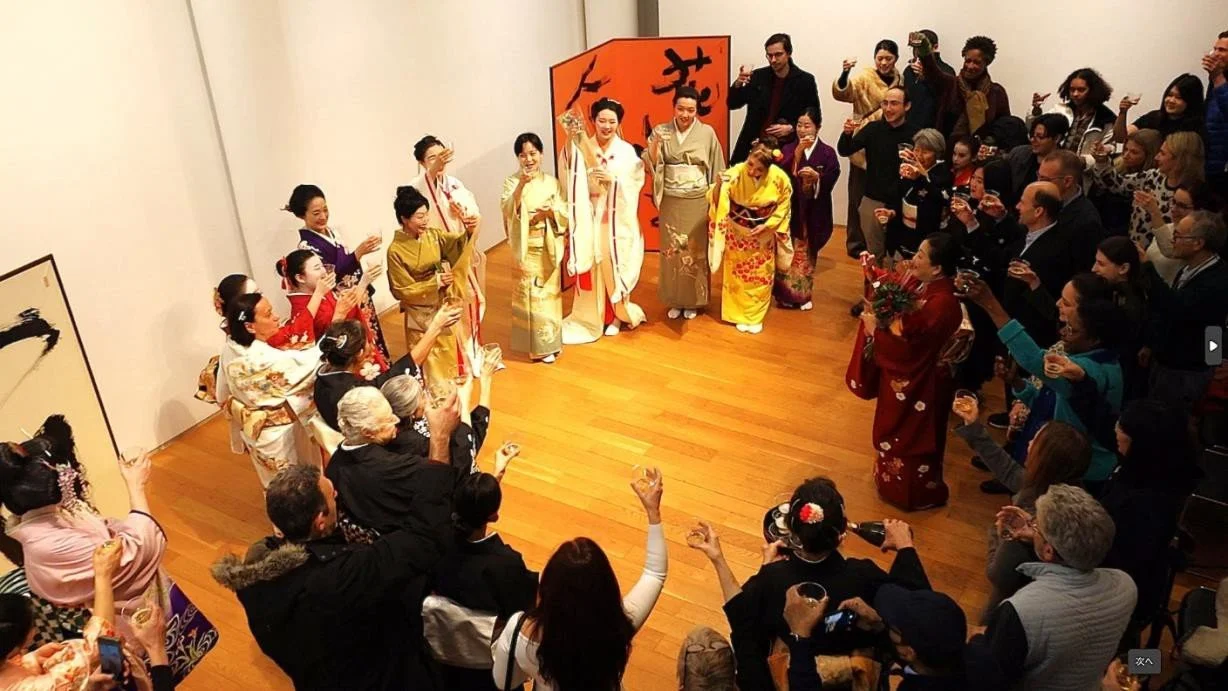
Odori-zome (New Year Dance) 2025 Photos by Jon Jung
The Bow: Entering Sacred Space
“Sacred Traditions Meet Art in Traditional Dancing:
Each class starts with a short bowing ceremony where both teacher and students greet and hope to learn communication from each other.”
-Ruth Berdah-Canet, Chopsticks NY August 2016
We begin dance lessons with a formal bow. How to bow properly is the first lesson I teach in workshops and in the first class for beginners. The bow is essential in learning Japanese traditional arts, including martial arts. We also take a bow at the end, expressing thankfulness of sharing what we learn in the class to classmates and teacher.
After kneeling, we first place a closed dance fan on the floor in front of us. My personal interpretation of this gesture is that the fan symbolizes one line, a line that divides our space into two worlds. The two worlds are the world of illusion, the theater, and the world of the surface, reality. I believe it is important that we are aware that we enter a sacred time and space of creation while learning dance. As a dancer and a teacher, I must say that the bow is far more than a simple greeting. It is “a dance” in itself with form, rhythm, and meaning.
As for the form, we keep our spine nice and straight. And for the rhythm, we take at least one breath, in and out, giving us a moment to pause and reflect on respect. As for meaning, we show respect to the teacher, to the heritage and tradition, to the colleagues with whom you share precious time in class. If a student accomplishes a beautiful bow in a workshop, it can be considered successful participation. Now that I have more group lessons than private lessons, I find it very meaningful for the students to bow to each other at the beginning and end of lessons because we learn from each other by sharing the class time. I believe those shared moments become valuable lessons, not only in dance, but in many other ways.
Indeed, teaching has led me to discover the worlds of my students; their beautiful eyes, filled with a curiosity that I hope they never lose, will always be reflected within my dancing, and within my own heart.
Wishing you a season of inspiration and new discoveries!
End of Chapter 13
©Sachiyo Ito All Rights Reserved