
Chapter 12: Reflections
Reflections at Year's End
As the season of reflection approaches, I find myself drawn to the many forms it can take, from quiet mental contemplation to the literal mirror of the physical world. In this spirit, I wish to explore several dimensions of reflection—not only to mark the closing of the year, but also to introduce the themes that will shape my upcoming memoir.
This chapter is not a retrospective of the events of 2024. Instead, it is a meditation on the self, followed by an exploration of the universe that surrounds us. It is a journey inward, then outward—a dual reflection that sets the stage for the New Year.
Tsuki no Akari wa Shimiwatari
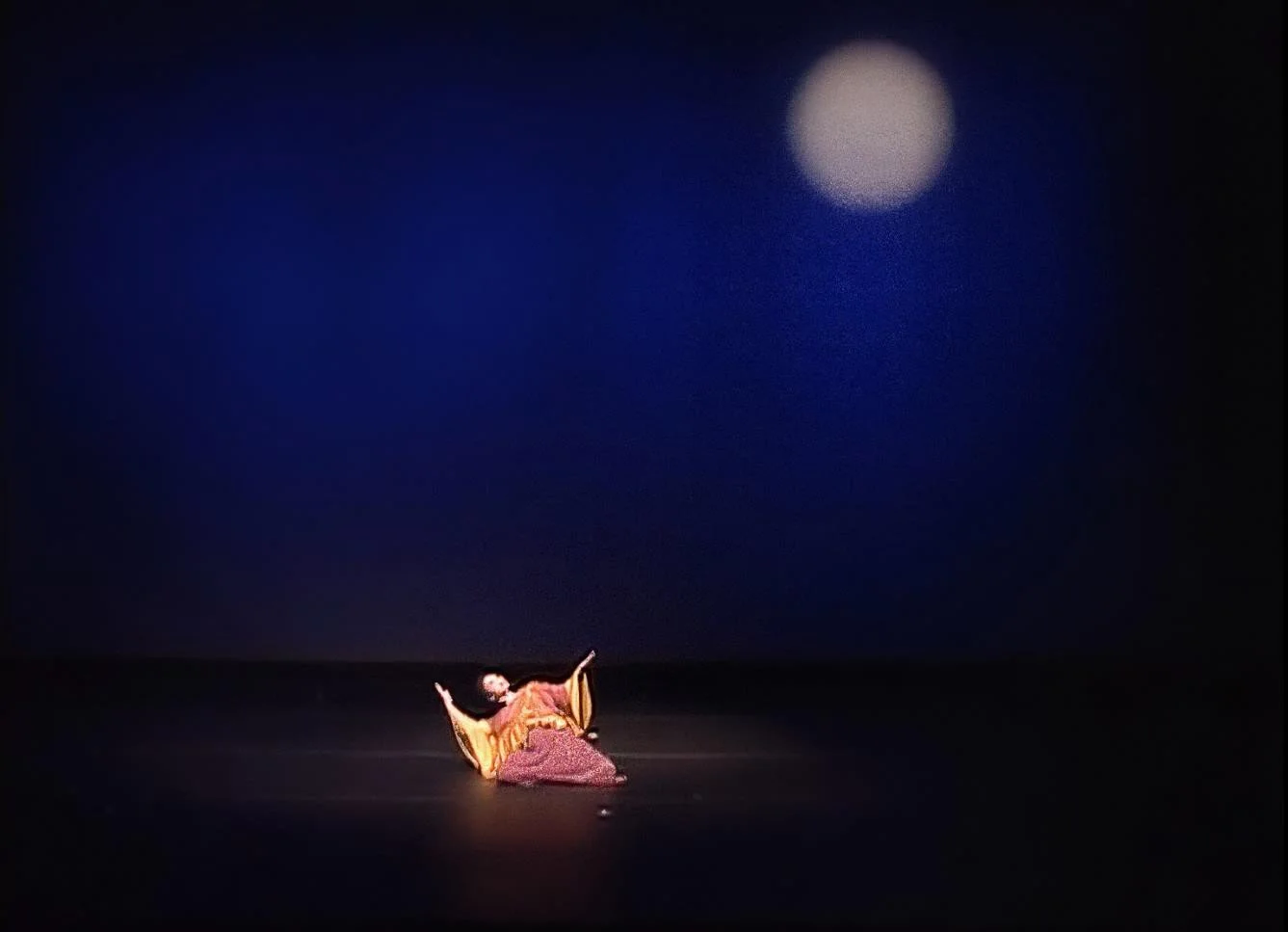
In 2005, for the 50th anniversary concert of my dance debut, I created a dance entitled Tsuki no Akari wa Shimiwatari (The Moonlight Penetrates Through), using music with the same title by Himekami.
Placing the moon image high above the stage, my hand gestures focused on mirroring myself as if using two mirrors, one in front and one in back. Then, I used hands to symbolize the two human beings in the story of the dance. Just as important as the hands were the shadows reflected on the stage floor, from time to time with one shadow overlapping the other. The shadows, the ephemerals, that you cannot possibly capture, were all that was needed to tell the drama of the dance.
During the 1950s at the dance studio of my childhood teacher, there was no mirror. My teacher’s thought was that you should not be watching yourself while dancing. According to her, to be conscious of your reflection in the mirror was not a good idea. I understood then that watching is a mental process, and that such intellectual activity is not dancing. This led me to discover what I consider the ideal state of performance. The best performance is when you are not conscious of yourself: You forget yourself, forget that you are the dancer. For me, the best performance is when I am not aware of myself, but I am just being in the dance, the body moving without thinking, without being dictated to even by the melody and rhythm. For your own body knows them. No mirror, no reflection of oneself is to be found here.
However, if we go back in Japanese history, we find a contradictory theory advocated by Zeami, the 14th century dramatist. He calls his theory “Riken no Ken” (“Viewing Oneself as Distant View”). It espouses an objective view: to be conscious of oneself analyzing one’s own performance. Can these two idealistic states co-exist?
Or perhaps he was talking about an even larger framework, that of the universe, and us under the stars, the moon, and sun. I wonder if we can step back while dancing, observe ourselves from all-encompassing angles, with the universe itself acting as our mirror?
宇宙より
おのれを見よと
いにしえの
釈迦、キリストも
あはれ教えき
窪田空穂 Utsuho Kubota
(Look at yourself from the universe, just as taught by Buddha and Christ.)
Kubota’s Waka poem above shares his deep insight: Look at yourself as a part of, or from a bird’s-eye view of, the universe.
In contrast to the universe, humanity is so small, a tiny entity in the immeasurable universe that makes me feel faint, and our existence and the drama we create in our lives seems so small. Indeed, we are nothing but a speck of dust, even less than a speck of dust.
But often our dramas become so huge and tremendous, more than we can manage with our emotions. Then, here comes a question: are we real, or in a dream, or nothing but dust? Are we watching shadows only, shadows we cannot possibly capture and hold, as in my dance, Tsuki no Akari wa Shimiwatari?
Actually, here is another view we can explore. There is each individual’s unique universe that reflects himself, while on the other hand there is the universe that contains all that surrounds us, the whole of existence. The universe is composed of experiences, encounters, nature, smiles of children, my dog’s happy bark, the sun, the moon, and water. The universe is what nourishes us and what watches us. Will it expand year by year, or by the experiences we gain, or by what we learn? I ask myself, “Is that a beautiful one, the universe that reflects me?” Oh, I doubt that... But how could a universe so rich in stories and lovely moments be anything but beautiful?
After many years of creation, The Moonlight Penetrates Through comes to my mind as a new lens through which to view the end-of-year installment of my memoir: the hands, the mirrors, the reflection of myself, the other human beings, many other beings, the sentient and the non-sentient, and then the universe itself.
Now, take a big breath in and out. With a smile, let us welcome our new universe.
Wishing you all the brightest and most beautiful 2025!
End of Chapter 12
©Sachiyo Ito All Rights Reserved