
Chapter 7: Dojoji: Dojoji 2001 and 2002
July finds us halfway through the year, as far from its beginning as its end. In traditional Japan, this is a time to perform Misogi, a purification ceremony meant to cleanse and renew the spirit. It is performed after half the year has passed. In modern times, we try to relax and enjoy summer’s slower pace, storing our energy for the busy autumn that awaits us; even Christmas feels like it is “just around the corner.”
Thinking ahead to the holiday season reminds me of the New Year’s Eve ceremony called Joya no Kane (Bell on New Year’s Eve), an important occasion for the Japanese to close out the year. During this event, a temple bell is struck 108 times. These 108 tolls represent delusions we have had during the course of the year, one driven out with every strike. Listening, we are slowly cleansed, and we can welcome the New Year with a fresh mind, soul, and body – a great panacea. The sound of the bell being struck and the resonance of sound after the strike helps us to meditate on the past year as it passes away from us.
Along with the bells of New Year’s, there is another bell that has rung throughout my life: that of Dojoji. You may remember the story of Dojoji from the previous chapter – a tale of transformation, revolving around a woman’s unrequited love and its disastrous consequence. The characters in the dance are a maiden and a monk, but it is arguable that the bell, although inanimate, is a character in and of itself, and a very important one.
“Sachiyo Ito is a graceful dancer/choreographer /teacher of quiet power. On April 2, 200I, she offered Dojoji 2001: an 'Evening of Japanese Classical and Contemporary Dance’… they crafted a subdued tension around the topic of unrequited love, in a modern interpretation of ‘the timeless drama of human desire and transformation.’"
-Madeleine L. Dale, Attitude 2001
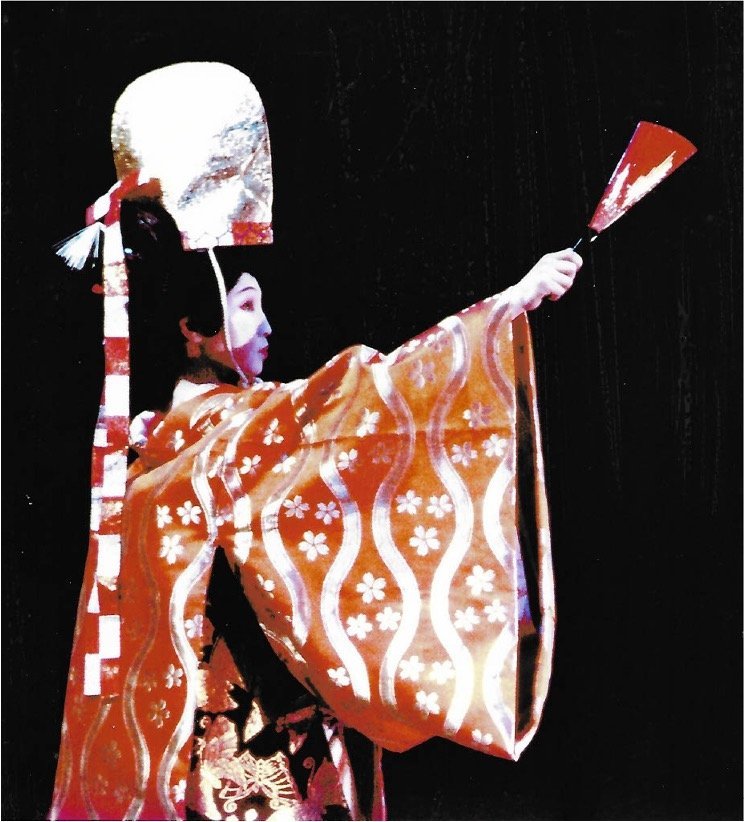
Kyoganoko Musume Dojoji at the American Dance Festival 1972
The Challenge
The legend of Dojoji is one of the oldest and most renowned tales in Japanese folklore. Originating in the eleventh century as a Buddhist morality story, it was later adapted into Kagura, a form of Minzoku-geino (folk performing arts), before evolving into Noh theater in the fifteenth century and Kabuki in the eighteenth. Its enduring popularity gave rise to a distinct genre known as Dojoji-mono. Today, the legend remains a cornerstone of Japanese performing arts, continuing to inspire modern dramas and films.
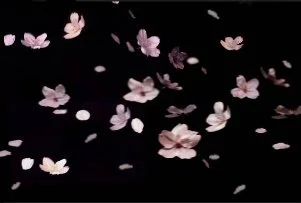
Creating a new work in the Dojoji canon can be considered a kind of revolt against tradition. It was a challenge to create my own dances for Kyoganoko Musume Dojoji (Maiden at the Dojoji Temple), Kabuki dance drama that was first staged in 1753. Among many Dojoji dance dramas, Kyoganoko Musume Dojoji depicts the sequel of the Dojoji legend, and is arguably the most enduring Kabuki dance. Incredible costume changes, breathtaking colors, and the dramatic change of the heroine from a beauty to a monster against the background of spectacular cherry blossoms have ensured its popularity over the centuries.
As a classical dancer, to perform Kyoganoko Musume Dojoji is considered reaching a pinnacle of one’s art, for it shows absolute mastery of dance and acting technique. One needs the permission of one’s dance school to perform it on stage. During my early years in the USA, my aim was to introduce the most emblematic dances of Kabuki to American audiences; therefore, I presented Kyoganoko Musume Dojoji at several concerts: the American Dance Festival (my debut in the USA), Riverside Church Dance Festival, and at events at Japan Society and Lincoln Center. I danced it just as I was taught to, every time, for many years.
Why then, after so long, did I take on the challenge of creating my own Dojoji dance? The answer is simple – I wanted to cut through to the heart of the dance itself. The heroine has emotions that are hinted at in a very subtle manner throughout the dance. However, the storyline gets lost in the accompanying lyrics and ends with an abrupt and surprising change of character. Coupled with the intense visuals on the stage – the many costume changes, the falling cherry blossoms – the dance seemed to me to be too ostentatious, becoming nothing more than a costume display.
Looking back now, I realize that some of my motivation lay in having seen many innovative works outside of Japan, particularly in New York. After almost thirty years of performing in the United States, I felt that it was time to create my own works. Perhaps I was too bold. But in those days, at the turn of the millennium, I felt a different awareness around me and hope for the new era. I wanted to see Dojoji with fresh eyes, in the context of the new epoch we were entering, rather than the usual story of love and hate. I wanted to focus on the universal theme of the human condition; a theme that transcends time and space, east and west.
During the 1990s, I was fortunate and blessed to encounter the teachings of Tich Nhat Hanh, and I created dances inspired by his poems. Then, as I began to perceive the Dojoji story as a new work, I could see my vision and choreography clearly through the lens of his teachings. I am more grateful to him than any words can express for the inspiration he gave me for both Dojoji and my life’s work.
In creating the new version, my goal was to expand on the themes of desire and destruction, but in a global context: obsessive desire for modern technology and material things leads to the destruction of environment and ecology; racism and tyranny result in wars among nations, and devastation of culture.
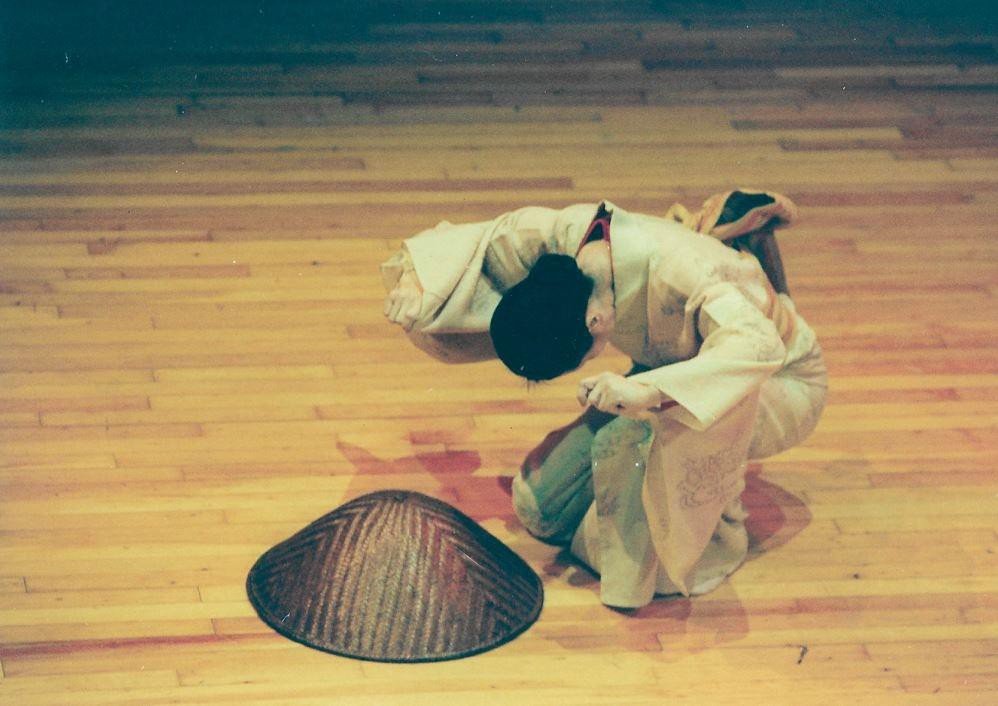
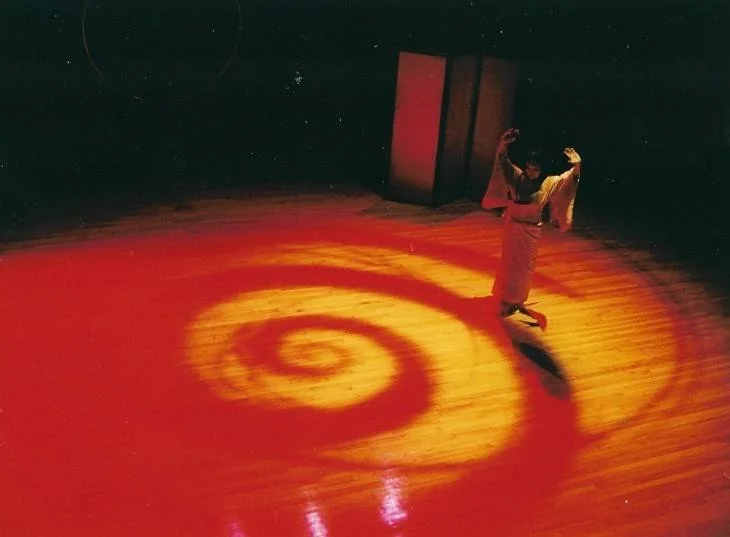
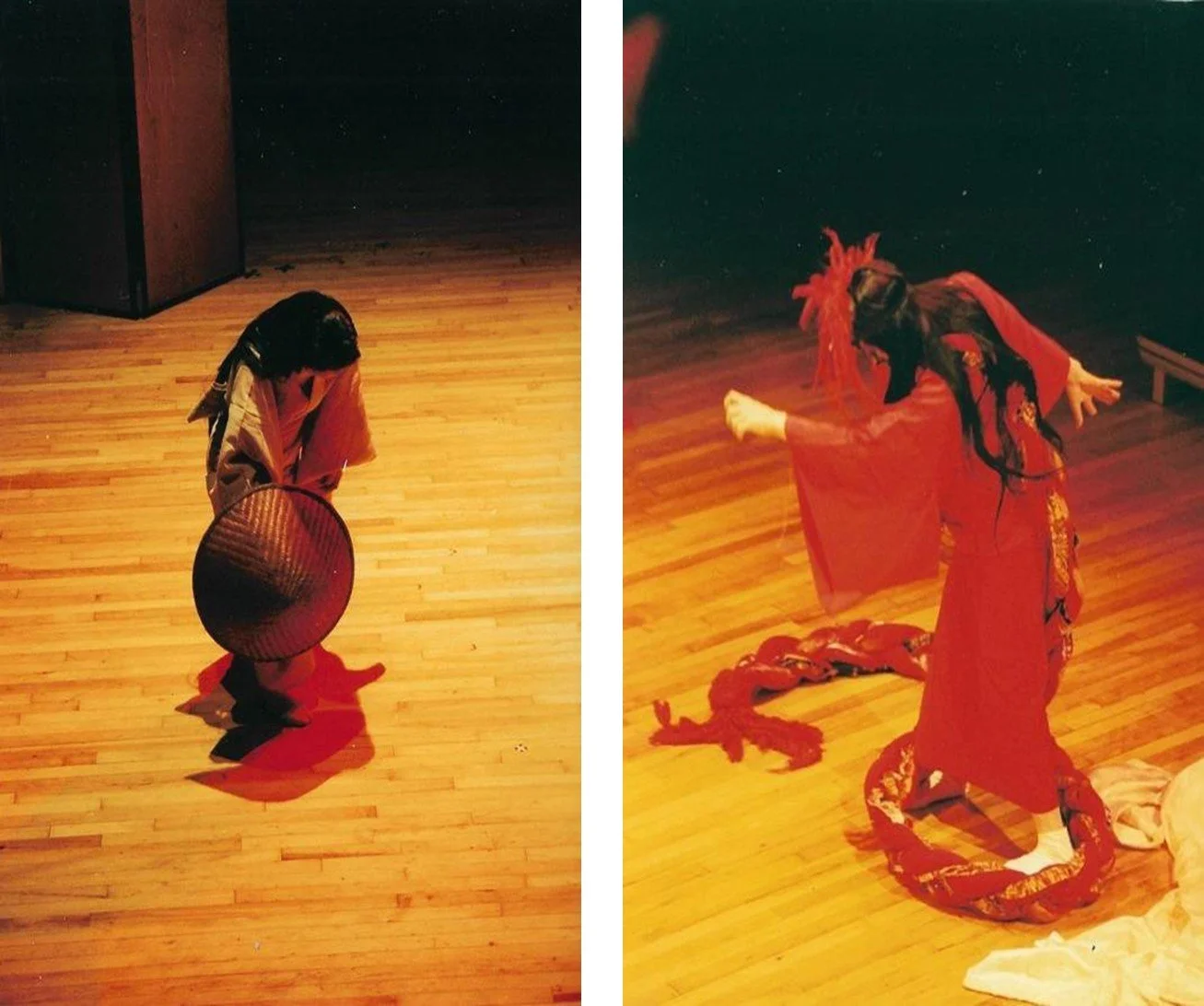
The first version of my entry into the Dojoji canon, Dojoji 2001, was presented at the Sylvia Fuhrman Performing Arts Center at the United Nations International School in 2001. The second, Dojoji 2002, was presented at the Theater of the Riverside Church for the 30th Anniversary Concert commemorating my American debut. There was development from 2001 to 2002 in the scale of the production – Dojoji 2002 had a longer performance time and more actors and dances, along with an expansion of music, poetry, and sets.
I recognize that I pushed beyond my limits—artistically, technically, and in terms of the resources available for production. However, in the undertaking, I realized that we could apply the global themes explored in Dojoji 2001/2002 on a personal level, resonating with our day-to-day lives. We witness our emotional turmoil reflected in the mirror—tired, angry faces staring back at us. How do we come to terms with ourselves? Is peace within our own hearts truly possible? Perhaps, if we can find inner peace, then peace on a broader scale might not be so far-fetched.
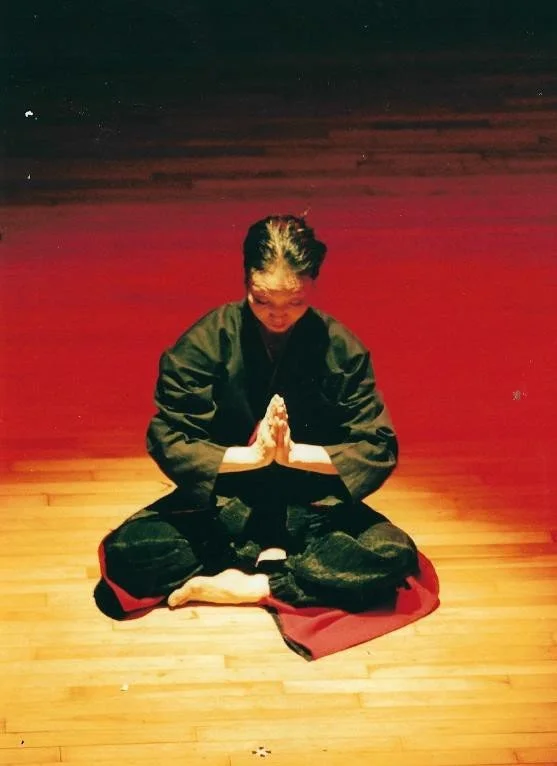
These questions inspired me to create a new opening scene: walking meditation. With each step, both performers and audience are invited to journey inward, drawing closer to the core of these reflections. If my work managed to pose these questions and illuminate these struggles for even one person, then every effort was worthwhile.
The Genre and the Bell
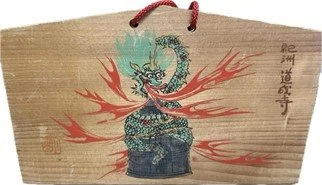
In the Dojoji story, the focus of the narrative is on love and hate between a woman and a man. A woman, Kiyohime, falls in love with a monk, Anchin, who spurns her advances. Rejected, she turns herself to a demonic serpent who chases the monk. When the monk takes refuge in the Dojoji Temple, the woman destroys both him and the temple bell, inside which he is hidden, by burning them to ashes.
The genre Dojoji-mono is divided into two groups: one that follows the original storyline; the other, a sequel that takes place a few hundred years later. There is a myriad of versions of the tale in the first group.
According to the Engi Emaki (Scroll of Origin of the Temple) handed down at the Dojoji temple, the sequel took place 400 years after the initial incident. Kyoganoko Musume Dojoji belongs to the latter genre.
In the sequel, the monks are preparing to raise a new bell to replace the old one. Although women are forbidden from entering the temple, a maiden defies the ban and gains entry by convincing the monks that she is a Shirabyoshi dancer.
Claiming to perform in honor of the bell’s installation, she begins her dance before the newly raised bell. As the performance almost concludes, she reveals her true identity as the demonic serpent from the original tale—and leaps into the bell.
The bell is of grave importance. For not only does it serve as a symbol of the woman’s desire, longing, passion, anger, jealousy, and eventual self- destruction, but it is also a symbol of taboo, human delusions, and attachment. It also functions as a symbol of Buddhism.
The importance of the temple bell in both Buddhist teaching and Japanese culture is illustrated by the opening lines of the medieval story, The Tale of the Heike Clan. The concept of impermanence is depicted most beautifully through the sound of bell as its ringing fades away.
The sound of the bell of the Jetavana Grove echoes the impermanence of all beings.
The color of flowers of the shala trees teaches us that the prosperous ones must decline.
The proud noble ones can live no longer than
a spring night’s dream does.
The strong warriors shall perish at the last. They are nothing but dust before the wind.
There is another play in which the bell takes center stage. In Miidera, named after the temple in which the play takes place (known as having one of the three best sounding temple bells in Japan) we find the same setup as Dojoji: the temple is off limits to women, and they are forbidden to enter. In Miidera, the woman has entered the temple to search for her lost son. In both stories, women enter the temple despite the prohibition, breaking a taboo in the process. However, in the former, the woman strikes the temple bell and is reunited with her lost child, evoking a sense of unconditional love. Here, the bell brings two people together and remains whole. Conversely, in Dojoji, the woman enters the bell, as if to be united with the man inside, and emerges as a snake, capable only of destruction. The bell illustrates transformation, but ruinously so, and lies broken in the end.
To elaborate on references and implications of myths of the snake throughout the world would take more pages than I am allowed here.
However, in Japan, the snake has been seen as a metaphor for the hideousness within, and to me, it is an expression for both the hideousness and ugliness found in the mirrored image of ourselves, caused by the negative seeds we carry within, such as attachment and anger.
I used to use the word for the story of Dojoji as “surrounding” the bell and the woman. The coiling, spiral movement and image around the bell illustrated the transformation in us humans and non-humans perfectly.
The Research
Prior to the creation of my work, Dojoji 2001, I researched its background heavily. This included visits to many folk performances of Kagura such as Kurokawa Noh in the northern Yamagata Prefecture, where Dojoji is titled as Kanemaki; Kumi Odori (Okinawan Court Opera), titled Shushin Kaniri in the south; and several performing arts in surrounding areas, including Mibu Kyogen in Kyoto. Of course, I also made the essential pilgrimage to the Dojoji Temple in Wakayama Prefecture.
Watching the Kurokawa Noh performance was a big assurance about the centrality of the bell in the story, as it is the essence that threads throughout the storyline. To me, the bell became the main character of the story. The other, presumed protagonist was not there; I said to myself, “Where is the handsome man?” The absence of the man becomes a source for our imagination and fantasy. An appearance of the man would destroy the fascination, although he has been depicted in plays and dances. To me, the imagination inspired by the story and symbolism of the bell seemed to be compelling enough on its own.
Upon visiting the Dojoji Temple, I was surprised to see countless donated plaques and photos displayed in the alcove of the main room of the temple, with words of prayers and gratitude. These had been offered by actors and actresses in kabuki, modern theater, and film who had visited the temple to pray for the success of their performances.
Another surprise was the number of tourists from around the country, as many as a hundred visitors a day – the count at the time when I visited the temple. I gave a sigh: the Japanese, young and old, through the ages and even now, have been fascinated by the Dojoji story. I took the hour- long group tour led by the Abbott, and we all listened intently to his convincing, vivid storytelling as he showed us the Engi Emaki scroll.
Since the Dojoji legend was born as a Buddhist morality tale, the scroll ends with paintings describing both Anchin and Kiyohime becoming Bodhisattvas, after being saved by the prayers of the Abbott, and entering enlightenment and reaching the Pure Land of Western Paradise. Another surprise! Such salvation does not happen in Noh and Kabuki, which I’m sure you can well imagine.
Then, I visited Hidaka River, because I was curious as to how dangerous it was to cross it. The Hidaka-gawa Iiriai-zakura (The Hidaka River at Twilight Cherry Blossoms) of Bunraku Gidayu (the puppet drama) describes the scene of Kiyohime’s transformation upon having to cross the wild and rushing river. The drama depicts the argument between Kiyohime and the boatman, who rejects her request to take her across the river in his boat despite her pleas, and this prompts her transformation.
Turning herself to a serpent, Kiyohime swims through the river, as long as 192 kilometers! But even before arriving on the riverbank, she had already run the distance from the Masago village, where she began her search. The road of the hunt for Anchin to Dojoji along the shore is now called Kiyohime Kaido (Kiyohime Shore), which is 960 kilometers. After the river, it is another 15 kilometers to reach Dojoji Temple. The length of the New York and Tokyo Marathons are only 42 kilometers (26miles), so she is the world marathon record holder. What a power her passion and desire propelled!
Upon arriving at the river, I was disappointed to find only a dry riverbed. Well, indeed, I thought to myself, it was a long time ago.
As for the cursed bell, ever since it was burnt down, reinstallation has never been successful. Every time a new bell has been installed, it is said to have brought disaster, such as famine and natural calamities.
Still, the site on which the bell stood has been enshrined. Though there was no bell, it has attracted visitors for many centuries – a good lesson in encouraging tourism.
Inspired by the comical direction of the Mibu Kyogen performance I saw at the Injoji Temple, I have incorporated comic elements in my choreographies of Dojoji, including dialogues between the monks and visits of modern tourists to the bell site. A humorous touch was often used to preach Buddhism to commoners in medieval Japan; those touches of levity also play a role in highlighting the impermanence we experience in our lives.
One of the caretakers of pilgrims and visitors to the temple was a lady in her ‘80s. She was incredibly kind to me on my first visit in 1999. Since I could not forget her help and kindness, I surprised her by returning to the temple in 2003. She was so pleased when I showed her the photographs from the performance of Dojoji 2002.
“The Bell at the beginning of the night echoes forth impermanence of life
The bell in the middle of the night
Echoes forth all that are born must die.
The bell at the dawn resounds with destruction of all, While the bell at dusk resounds with infinite joy
that invites those who leave the mortal pleasures to Nirvana.”
From Kyoganoko Musume Dojoji
In these lyrics, as well as similar lyrics in the Dojoji in Noh, the bell and its toll symbolize Buddhist teachings of impermanence, as we mentioned earlier. Further, the bell has another representation as well: that of salvation. The physical construction of temple bells was costly, and a donation to the temple for this purpose was seen as an act of repentance. Pious donations could pave one’s path to Nirvana. Across centuries, women have donated precious combs and hair ornaments in hopes of salvation. This tradition, the list of donations in countless temples, becomes especially poignant when viewed through the lens of the Dojoji legend.
There is a phrase in the lyrics of Kyoganoko Musume Dojoji that keeps running through my mind. “The clouds of the Five Hindrances are cleared now, so now I can watch the moon that shines the truth.” That means we women supposedly to have five hindrances for reaching enlightenment, since we have delusions and desires, and are not pure.
In my youth, I used to think, “So men are pure, clean and have no delusions?!” In both Miidera and Dojoji, women were able to break the taboo and enter the temple, but the problem was that there was a taboo to be broken to begin with. My naïve impression was that most temples (depending on the sect) were very discriminatory. I took this question to my teacher. Perhaps she thought I was too young to understand the meaning of the words, as she only suggested that I go up a mountain to watch the clouds clear from the sky. I did go up somewhere to watch the sky. This did help in executing one movement with a fan, for it became deeper once I had a better picture of the landscape in my mind, but I did not achieve any clarity on the Five Hindrances! It was only much later, when I found the concept expanded on in an encyclopedia, that it became clear. The ultimate teaching is, of course, that both men and women can enter Buddhahood through Buddhist Practice.
The Fantasy
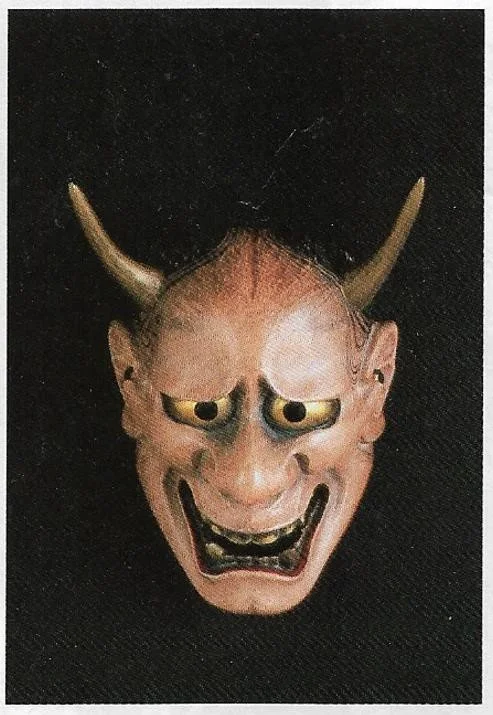
Surrounded by the full-blown cherry blossoms, beneath their gently falling petals, a beautiful dancer performs and charms the temple monks. Suddenly, she transforms into a demon. In Noh, the mask used for this role is called Hannya, a demonic mask is used to portray women in the throes of jealousy. There is a distinct lack of demonic jealousy masks for men. Why have there been no such demons in classical plays? Well, men wrote the plays. They wanted to be loved and chased as much as they wanted to die heroic deaths. Or perhaps, was it a playwright’s act of revenge to write about jealous women, a reflection of his own unrequited love? Was it simpler – just an awe of one sex towards the other?
The Collaborators
Robert Mitchell, who created many sets for Broadway and off-Broadway shows, was so gracious as to collaborate with me again after my productions of Poetry in Motion at Lincoln Center’s Clark Studio Theater, and Joyce SoHo in 1990 and 2010. It was he who created the bells for my production of Dojoji. Without the bells he created, my Dojoji would not have had the impact it did. They served successfully as a symbol for the timelessness of the themes of the story.
One bell was a replica of the Noh theater style made in damask, while the other was his own interpretive creation. His second bell was ingenious, transforming mid-performance. It began as a ring on the floor, which rose towards the ceiling at the sound of the first bell. Thus, the shape of the bell materialized, telling us that a centuries old story has awakened and now repeats, hinting the universality of the themes. I had a Buddhist novice striking the classical bell, as the act of awakening the spirit of Dojoji.
My hope was that the toll of the bell would evoke the timelessness of an endless cycling story. The striking of the bell would also awaken the ghost of Kiyohime from her long sleep, then drive her to the bell, the symbol of her desire and anger.
I must commend Bob’s amazing professionalism and willingness to go above and beyond in his work. For example, to make a special sacred area on the stage, he suggested that we go to a carpet store and look for a carpet that could allow me to dance with a gliding walk. This seemed an impossible idea to me, but after looking at many materials at the carpet store, and eventually we found one! He was also known for his accuracy of measurement creating exact diagrams for building stage sets, which once led him into a heated argument with the theater staff about its measurements and specs in one of the theaters where we had productions. I recall the unforgettable, innovative and beautiful sets he made to depict underwater and sacred shrine scenes at the French Alliance Theater for the 25th Anniversary of my debut in USA in 1997.
In 2006 I visited Bob at his home. He was bed-ridden, but he and I were able to exchange smiles.
The following day, he passed away.
For many years afterwards I used to think about the bell he had made.
One day I visited Patrick, his friend, in their loft. It was a brief visit. He came to the door in a wheelchair that had to be lifted up the stairs by his aide. I was grateful, even though we only had a chance to exchange a few words. His eyes were as gentle as Bob’s.
I was also fortunate enough to work with creators such as the mask maker Sarah Bears and the costume designer Reiko Kawashima. I still have the stuffed snake Reiko made. How she carried the heavy and enormous snake to the Riverside Theater, I still do not know. We worked together often, and she became my favorite designer for other dances.
For Dojoji, I worked with young male dancers who were either hip- hop dancers or trained in classical ballet, and it was a very interesting experience for me. In addition to Dojoji, I trained them in an Okinawan dance piece, accompanied by drumming, happy tunes, and fun-filled movements, to contrast with Dojoji’s heavier story. Meanwhile, for Dojoji, I fused Okinawan dance movements and elements from the Minzoku Geinoh with the classical male style dance as its choreography. I was very pleased that they could incorporate these mixed styles.
I cannot list Mr. Yamashiro (Shoji Yamashiro Aliases: Ohashi Tsutomu) as a collaborator, but as an artist who contributed to creating Dojoji 2002.
Like fate, I came across his music, Gaia Echophony. I asked for his permission to use a part of the work, and he was so kind as to encourage me to use it. I incorporated it with live music and other newly recorded sounds. That word – Gaia – pursued me then. It was such an intriguing word.
Twenty-five years ago, we were not as aware of the words “climate change” as we are today; words which now alarm us as we realize the threat to current and future generations on earth. I discovered the Gaia Hypothesis, an idea that took hold of me and never let go. Gaia comes from Greek mythology; she was the goddess that personified the Earth. The Gaia Hypothesis is the idea that Earth and all of its biological and ecological systems form one single entity. Whether you believe it or not, understand it or not, one must at least acknowledge how deeply we are interconnected with the world around us. Humans and other beings, both sentient and non-sentient, cannot exist without others. Chains of events affect everything on the earth, both in positive and negative ways, and climate change has now become the most pressing matter. The very interconnectedness that defines us has the power to destroy us. If the changing world is the strike on the bell, are we doomed to fade away in its echo?
Looking back at my work now, I can say that I was headed in the direction to explore these concepts, but I did not sufficiently coax them to the surface. Then, I was unable to do so within my capacity; that exploration was beyond my comprehension and vision. Now, at this age, and as I write my memoirs, I have begun to seek a way to express it, even if only in a minor way, with my next project.
Gaia, nature, and the dance…
My Mother’s Funeral
My mother battled illness for eight years. As her only daughter, my brothers looked to me to be by her side. A year after the onset of her condition, I cared for her in New York for ten months, followed by a month of treatment at a hospital in Massachusetts. Eventually, she returned to Tokyo—her home and the place where she felt most at peace.
Throughout those years, I flew to Japan whenever her health took a turn for the worse. I made more than twenty trips between Tokyo and New York. The final journey was for her funeral; I arrived straight from the airport in the midst of her wake.
The next day was her funeral and cremation. I placed a postcard for the Dojoji production in her coffin beside her, dressed in a white kimono. “I am very sorry, Mother. Please forgive me, though I cannot stay and accompany you to the crematory. I hope you understand. Please watch the dance from up above.” We were in tears as we gathered around her to say goodbye. I had to leave immediately to catch my flight back to New York—Dojoji 2001 was set to be performed in less than a week.
In my life, canceling productions or performance engagements due to personal or family matters has not been an option. For that matter, even when I broke my foot, I continued to perform more than a few times.
At that moment as I stood by the coffin, there was nothing in my head. It seemed that time froze as if we were in eternity.
Empty Bell
Press against our hearts Bell of empty resounding. Your dying note, an Amulet across eons:
The medallion of desire
……
Beauty of Gesture
Is captured after it
Has been lost: voidness Embraces us, puppets of
Play in a cave of shadows.
Since nothing endures, nothing is destroyed; since Nothing is, nothing
Is not, since there is nothing To know, knowing is nothing.
-Mackenzie Pierson 2001
The bell and the man were burnt to ashes, and we all return to the earth.
End of Chapter 7
©Sachiyo Ito All Rights Reserved