
Chapter 1: Poignant Memory
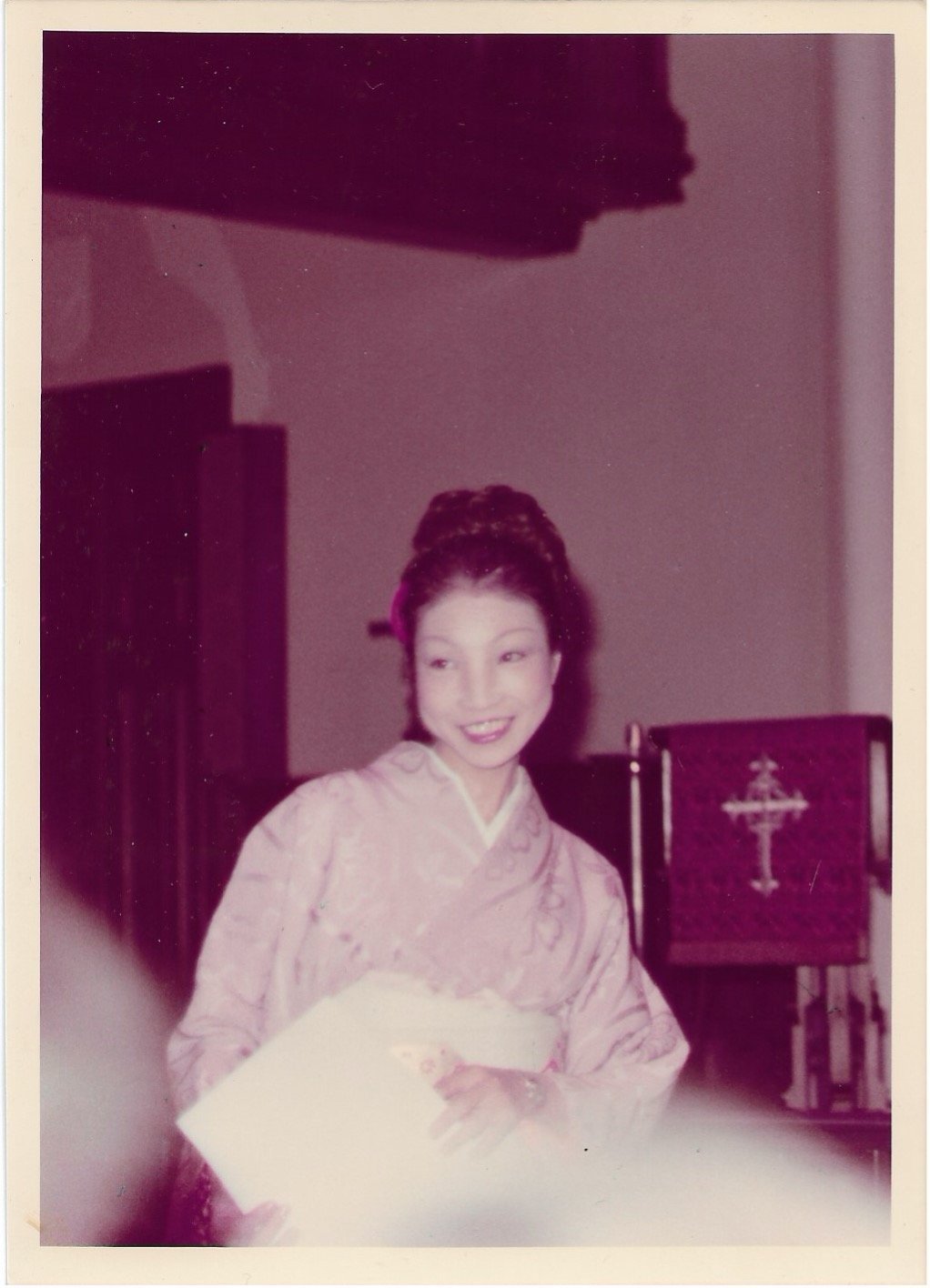
Sachiyo Ito at Tamiki Ito, one of her brothers’ wedding 1975
“Control and Grace in Ms. Ito’s dance”
Don McDonough, New York Times, April 19, 1994
Poignant Memory
It is a poignant memory, sometime in the ‘90s. I stayed a few weeks at my old home in Tokyo. I came across a photo taken by my brother who had just discovered an exciting new device, a photo camera. I was his first model. I was 5 or 6 years old. In the aged photo, a little torn in one corner, I was smiling as if I had no worries in this world and expressing joy for being under the beautiful afternoon sunlight.
Then I started to cry because I realized that I had been clenching my teeth to carry on my mission since I began my work in America, without financial resources, taking all kinds of jobs to survive, regardless of circumstances like robberies and the dangers of almost being killed. I never had smiled so naturally from the bottom of my heart. There was a passion, a driving force within me, but I don't think I was experiencing happiness in any part of my life.
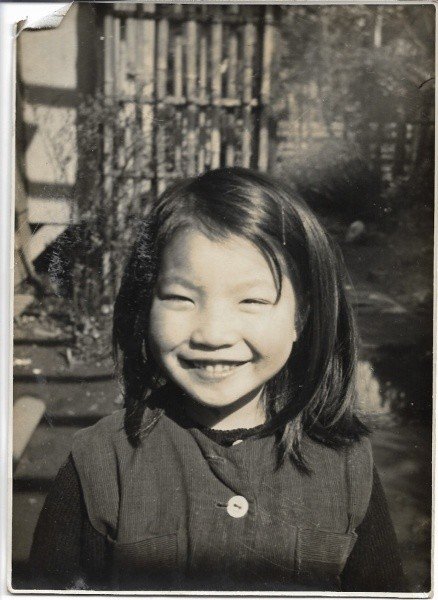
Sachiyo at age of 5~6
As a professional, I faced my students and audiences addressing them about Japanese arts and culture with "smiles."
Luckily my work has been reviewed numerous times by the New York Times, Dance Magazine and other arts publications for my tours around the USA, and work in New York. I only glanced at them and never fully read or appreciated the reviews, perhaps with a sense of incompleteness of my life and that I had to go onward without reflections.
It is true that many artists may be fighting with themselves, clenching teeth, to perform, working hard with the feeling, "I've got to do this!" No matter what adverse situations and conditions there are, there is a sense of righteousness that artists can send a message for the betterment of the world through the arts by making it possible to touch people's hearts. I wonder if the artist is nothing but a thirsty human being who has to share feelings and ideas with others?
I remember my older brother calling me Kawara Kojiki, a "beggar at the riverbank," as performing artists in Japan were referred to in the past. In some sense I have been that, but I didn’t mind. So, my response was silence and only an inner voice said “So what?”
I remember my older brother calling me Kawara Kojiki, a "beggar at the riverbank," as performing artists in Japan were referred to in the past. In some sense I have been that, but I didn’t mind. So, my response was silence and only an inner voice said “So what?”
In Japanese classical dance, Nihon Buyo, to present a performance, centuries-old traditions and authenticity require great resources. What a difficult fight it has been to obtain these requirements.
Seeing my smile as a child, I realized my life is not hard but blessed as I was able to do what I believed in. Even though I was pursuing an ambitious and wild mission, I could carry on, thanks to my mother, friends and all conditions that allowed me to do what I had to do.
With a sense of gratitude and acknowledgement of hard work and consolation I feel how blessed I am to do what I believe in. No need to clench my teeth, for I can carry on life as it was meant to be. I can embrace what I have and what I can do with joy, otherwise there is no meaning in life. Now I can smile perfectly at flowers, blue sky, sunshine, and people.
A human being is amazing, one who can do unbelievable things when he looks back. Nature is full of miracles. So, I say to young artists, yes, endeavor and pursue your path even if it has changed course or made a big turn. Life with passion and belief cannot be more beautiful. Let us do everything with joy, though. It will make a better art of whatever we are making. I often wonder if mine is not an “art” …or could be a mere rubbish. But still, I believe a sincere offering of the heart can be called art.
Here I Am as Kawara Kojiki

At Greenwich Senior Center in New York City
This past spring, I was giving a workshop at a senior center near Washington Square Park. The area is the college campus, where I used to walk as a student of NYU more than 50 years ago. The campus around the park is where you can see Kawara Kojiki every day. The same as with Union Square Park and many other parks and subway stations.

Sachiyo Ito and Company at Sakura Matsuri, Brooklyn Botanic Garden
When I came to America with a one-way ticket and a suitcase with three costumes and a few kimonos, I never imagined being here for so many years. But one job led to the other, and to another, and like a snowball rolling down the hill, it seems that the years passed by quickly while I became a teacher, dancer, and choreographer of Japanese Dance and Artistic Director of a dance company.
About Kawara Kojiki, the name my brother claimed for me, did not seem to matter to me, because I am the one, regardless of the name being disgrace. But it also shows an important element as a performing artist: Gratitude and humility — even for the smallest thing — was part of my training. My Mentor’s words: you do not lose anything by bowing. To feel grateful for anything a part of my training.
Whatever others say, there is a calling inside of us. I believe what inspires us most will lead our path.
I don’t know why, but ever since I can remember in my childhood, I used to think about life and death. I was 6 when my grandmother passed away. I remember that I did not understand her death. I was scolded for being excited during the funeral. For, it was like a festive occasion because there were so many people gathered at my house that was surrounded by a lot of food and flowers.
After the funeral I suddenly came to realize that my grandmother was no longer with me, and that death was coming to me also. The idea of death scared me so much that I clung to the housekeeper.
Then, if I only had one life to live, I would want to live it to the fullest, while on the other hand, I was praying to be reborn many times in various incarnations.
People ask me, "What do you like about New York? Is it easy to live there?” I believe that "living" is the same no matter where you are, and that each person's life has its own uniqueness and brilliance, regardless whether it is painful, sad, beautiful, or joyful.
I have been living my life with too much tension, holding my own mission in my heart to introduce Japanese dance to the world and to play a part in cultural exchange. Putting aside the immaturity of my own art, I have lived my life with ambition, wanting to confirm my life through dance. And New York provided me with a place to do so.
Early Days: Childhood and Dance Training
I was born on July 31, 1949.
I began my classical dance training with Hanayagi Sakura at the age of six.
It is said that in learning “performing arts,”, the training should start at the age of six years and six months. This teaching was first advocated by Zeami in the 14th century in his treatise, Fushikaden. But in many kabuki and dance masters’ families they begin their children’s training even at three years old, just as I witnessed my Noh teacher teaching his three-year-old son.
There is an image of a late afternoon light coming through the living room. I was five or six years old, nagging my mother, moving her shoulder back and forth, “Mother, please let me take dance lessons.”
My desire was turned down at first, because my mother was a single mother, unique in the 1940-50s. She had to raise three children, so our means were very limited.

Kamuro Toyoko Theater, Tokyo, 1956
However, several months later, I was allowed to take lessons on the condition that I go to the dance studio on my own, for there was no one to take me there and the trip took an hour with changing trains.
I began taking lessons twice a week at the studio of Hanayagi Sakura. She was the sister of the wife of Takeo Takagi, the editor of the Yomiuri Shimbun Newspaper, where my mother worked. I recall gathering my friends in the neighborhood and teaching them dancing as I sang, and held up a case of a dance fan, which amuses me now. What was I doing?
Sometime during elementary school, I decided I would like to be a dance teacher and performer. I decided one thing during my childhood. I would not get married, which was absolutely a ridiculous idea. Because Sakura sensei was single, and while my mother was not married (she was single since I was 3 years), she was too busy with work with no time to see her children except on special occasions.

Tomoyakko Toyoko Theater, Tokyo, 1959
I was a lonely child, so to speak, almost like no mom or dad ever existed in my life. I thought, if I pursue my career, I would not make my children unhappy like this. Then later, Shotoyo sensei, my second dance teacher, made me change my mind. Seeing how wonderful it was to have a family like hers, and realizing that marriage and having a family would make a richer life that would contribute to richer expression as an artist. Also, a family’s support for work and career is very important. Certainly, I wanted to get married too, but the truth is no one wanted to get married to me if I pursued my career.
Despite my desire, to have a career in the Japanese dance circle required financial support from one’s family or other supporters, which was not possible in my case. And yet, I wanted to pursue my dream of dancing. Further, my little voice used to say, “I only have one life. I want to make my life worth living as a human being, and I want to contribute to society.” Such a bold proposition for a teenage girl, who was ignorant of the world and the weight of such an endeavor.
Also, there was someone who inspired me a great deal. She was another student of Sakura sensei, Hanayagi Kosen. I witnessed her dancing when she was preparing for her recital to announce the opening of her own studio. She looked so beautiful, even if she is not what we call a “beauty.” I realized a transformation happens when one puts all of their energy and heart into one thing.
She was truly alive, shining, emanating her beauty and light. In her case, giving the recital to commemorate her teaching certificate was her milestone in her career. The realization of her dream made her such a beautiful person full of radiance.
Then, later in my adolescence, I began to dream of working outside Japan and sharing the beautiful art of Japanese dance with people from other cultures. After much reflection, it seemed more feasible and less costly, even without coming from a millionaire family.
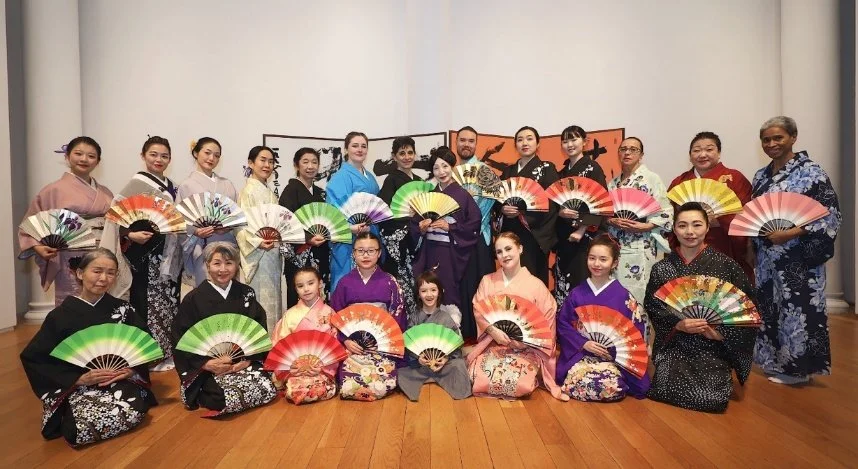
Sachiyo Ito and Company New Year Dance Odori-zome (2023)
It was too big of an ambition since I did not know anything about Japanese dance yet. Reflecting now, after more than 50 years of teaching and performing, I feel I still do not know enough about dance. Even when I started working in the United States in 1972, I had little idea what dance is, the depth of the art and tradition, and the huge heritage of the culture. Maybe such a realization is true in any art: the longer you trod on the path, the more you realize and how little you know and understand about art. It is immeasurable. But perhaps that makes it worth pursuing and learning.
End of Chapter 1
©Sachiyo Ito All Rights Reserved